
TL;DR

Get kitchen gear delivered free with Prime
- Fast, free delivery on millions of items
- Prime Video, Amazon Music and more included
- Member-only deals all year
Researchers from the University of Reading and the Animal and Plant Health Agency report that violet-blue photodynamic inactivation killed all 64 Campylobacter strains tested, including strains with different antibiotic-resistance profiles. The contact-free technique uses light without added chemicals, but further trials are needed to establish whether it can reduce contamination on chicken in practical settings.
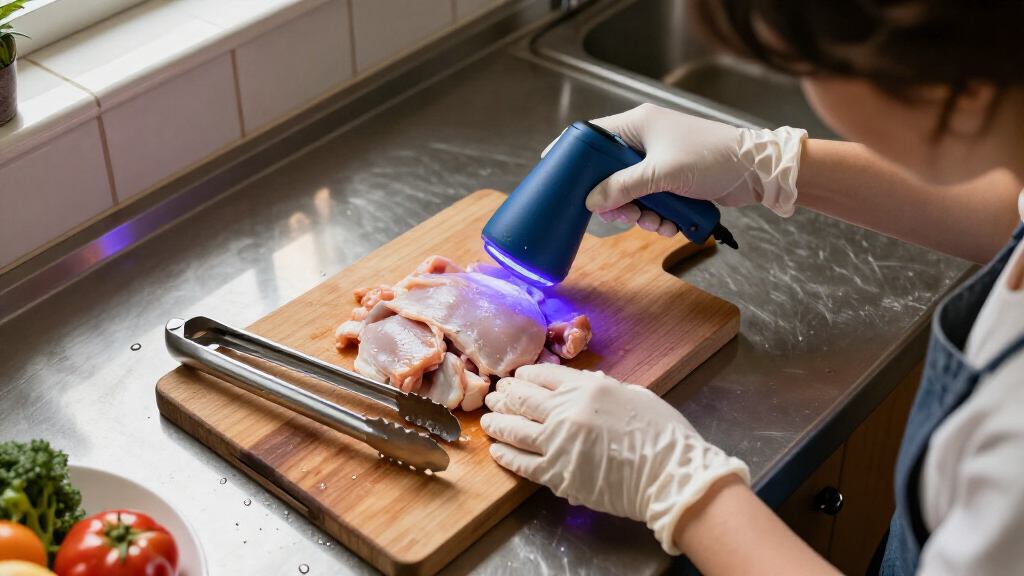
Researchers from the University of Reading and the Animal and Plant Health Agency report that a violet-blue light treatment killed all 64 Campylobacter strains tested, including strains with different antibiotic-resistance profiles. The findings suggest the contact-free technique could be explored as a way to reduce the foodborne bacteria on chicken, though more trials are needed before its practical effectiveness is established.
The researchers tested a method known as violet-blue photodynamic inactivation, or VB-PDI, against 64 different Campylobacter strains. According to the study findings summarized by Food Safety News, the treatment killed every strain tested, regardless of its species or antibiotic-resistance profile. The supplied report does not provide the test conditions, treatment duration or the amount of bacteria remaining after treatment.
VB-PDI uses light and does not require direct physical contact with the food or the addition of chemicals, according to the report. Those features make the approach a potential option for food-safety research. However, results from testing a set of bacterial strains do not by themselves establish how well the technique would work on chicken under processing or household conditions.
The report describes the approach as promising but says additional trials are needed. It does not state that the method is in commercial use, approved as a food-safety treatment or proven to prevent illness. The findings concern bacterial strains tested by researchers, not a documented reduction in Campylobacter infections among consumers.
Potential to Reduce Chicken Contamination
Campylobacter is identified in the report as the most common cause of bacterial gastroenteritis worldwide. The report says the United Kingdom recorded 70,000 laboratory-confirmed cases across 2024 and 2025. That figure represents cases over the stated two-year period; the source gives no comparison baseline or annual breakdown.
Chicken is relevant because the report says Campylobacter is killed by cooking, while cross-contamination during handling of raw meat is thought to be a major route of infection. A treatment that can reduce bacteria on food before it is handled could, if future testing supports that use, add another possible control point. The study does not yet show that VB-PDI achieves this outcome in routine food production or prevents cross-contamination in kitchens.
The contact-free, chemical-free features may make VB-PDI worth investigating alongside existing food-safety measures. For now, its importance lies in the reported laboratory result and the potential to test the method further—not in a confirmed change to guidance or practice.
As an affiliate, we earn on qualifying purchases.
From Strain Testing to Chicken Trials
The study examined 64 Campylobacter strains, with the reported result applying across species and antibiotic-resistance profiles. That breadth is relevant to the researchers’ finding, but the source material does not specify how the strains were selected or whether they reflect the full range of bacteria found in food-processing environments.
The next evidentiary step is to establish whether the light treatment can reduce Campylobacter on chicken itself and whether it can do so consistently under relevant conditions. Food Safety News reports that more trials are needed, but the material supplied does not name a planned trial, timetable or commercial partner. Until such evidence is available, VB-PDI should be understood as a research technique rather than an established food treatment.
“Every strain was killed by the treatment, regardless of species or antibiotic resistance profile.”
— Food Safety News, summarizing the study findings
UV light chicken surface disinfectant
As an affiliate, we earn on qualifying purchases.
As an affiliate, we earn on qualifying purchases.
Questions Before Food Use
The supplied report does not give the study’s detailed methods, including the light dose, exposure time, test setup or the measured reduction in bacterial numbers. It is also unclear from the material provided whether testing took place on chicken, in a laboratory suspension, or under both conditions.
Further work would need to show whether the technique performs consistently on chicken and under realistic processing conditions. The source does not report effects on food quality, the treatment’s operating requirements, its cost, or how it might fit into existing food-safety systems. Nor does it provide evidence that VB-PDI has reduced consumer infections. Those questions remain open; the reported result alone does not establish safety or effectiveness at commercial scale.
As an affiliate, we earn on qualifying purchases.
Further Trials Needed on Chicken
More trials are the next stated requirement before the technique’s usefulness for reducing Campylobacter on chicken can be judged. The source material does not identify when those trials might take place or which specific conditions researchers plan to test.
Evidence from further testing would need to clarify how reliably VB-PDI reduces the bacteria on food and whether the effect holds in practical settings. Until additional results are reported, the finding remains an early research result, not a replacement for established measures such as thoroughly cooking chicken and preventing cross-contamination while handling raw meat.
photodynamic inactivation food treatment
As an affiliate, we earn on qualifying purchases.
As an affiliate, we earn on qualifying purchases.
Key Questions
What is violet-blue photodynamic inactivation?
VB-PDI is a light-based technique tested against Campylobacter strains. The report says it does not require physical contact with the food or added chemicals.
How many Campylobacter strains were tested?
The researchers tested 64 strains. Food Safety News reports that every one was killed by the treatment, across the species and antibiotic-resistance profiles represented in the tests.
Does the study prove the method works on chicken sold to consumers?
No such conclusion is established by the supplied report. It describes the method as promising and says more trials are needed; it does not confirm commercial use or effectiveness in routine food processing.
Why is Campylobacter relevant to chicken safety?
The report describes Campylobacter as the most common cause of bacterial gastroenteritis worldwide and says cross-contamination from handling raw meat is thought to be a major infection route. Cooking kills the bacteria, according to the report.
Source: rss
Fall Picks
fall essentials
As an affiliate, we earn on qualifying purchases.