TL;DR

Get kitchen gear delivered free — and shop member deals
- Fast, free delivery on millions of items
- Access to Prime Big Deal Days deals on October 6–7
- Prime Video, Amazon Music and more included
Air fryers for small kitchens work best when their footprint, usable basket area, and ventilation needs match your space and typical portions. Measure your counter and storage before buying, then weigh cooking capacity against cleaning, noise, and features you will actually use. A small air fryer can crisp quick meals efficiently, but it does not automatically replace an oven or make food healthier.
A tiny counter can make a large air fryer feel like a permanent tenant. Before you buy, measure the spot where it will sit and the cupboard where you plan to put it away.
Air fryers use a high-speed convection system to move hot air around food, helping brown and crisp it with little or no added oil. This guide shows you how to compare real footprint, usable capacity, safe placement, and everyday features so your new appliance earns its space.
Measure the counter, storage space, and manufacturer-required ventilation clearance before buying.
Compare basket shape and single-layer cooking area, not only the capacity printed in quarts or liters.
Choose basket or oven-style models based on the meals you cook and the counter space you can spare.
Avoid crowding food; dry fresh ingredients, shake or turn them, and cook in batches when airflow is limited.
Check cleaning instructions, noise, warranty, and replacement parts alongside the price and preset count.
How an air fryer earns its place on a small counter
Air fryers for small kitchens are countertop appliances that cook by circulating hot air around food, often crisping small portions faster than a full-size oven. That speed comes from heating a compact space and moving air close to the food, so there is less oven cavity to warm first. For one serving of potatoes, reheated leftovers, or a tray of vegetables, that can make a quick meal feel practical. For a large meal, the small cooking area can erase the advantage if you need several rounds.
They can also roast, reheat, and bake, depending on the model. But air frying is convection cooking, not deep-frying: moving hot air can dry and brown exposed surfaces, while immersion in oil creates a different crust and texture. Frozen fries may need no extra oil because they often have oil on their surface already; fresh potato wedges can brown more evenly with a light coating that helps heat transfer and surface browning. The result depends on both the food and how much room air has to move around it.
Imagine getting home late and cooking one portion of salmon and broccoli. A compact basket may get dinner moving without warming your whole kitchen, while a big oven-style unit could occupy the counter for a meal it handles easily. If you regularly cook for several people, though, repeated batches take time and the first food may cool while the next cooks. The payoff depends on your portions and routine.
Measure these four things before choosing a size
Air fryers for small kitchens need to fit the counter, storage spot, typical portion, and ventilation clearance—not just the empty space shown in a product photo. The listed dimensions describe the appliance itself, while safe operation may need extra room around vents or above the unit. Check the appliance’s full dimensions and its manufacturer’s instructions before you decide that it will fit.
- Measure the counter. Check width and depth, then see whether nearby cabinets leave the clearance the manual requires. A unit that fits only when pushed against a wall may have nowhere safe to sit during use.
- Check the storage route. Measure your cupboard and the path to it; a heavy appliance that barely fits may stay out permanently. Consider whether you will have to lift it over other items each time. If storage is inconvenient, the counter footprint matters every day, not just on cooking nights.
- Match portions to usable area. Ask whether your usual food can sit in a reasonably even layer. Basket shape matters as much as its listed capacity: a deep, narrow basket can hold a lot by volume but leave little bottom area for food that benefits from being spread out. Stacking may increase quantity while reducing airflow and even browning.
- Plan for vents and power. Keep intake and exhaust clear, follow the maker’s placement guidance, and use the specified outlet. Vent placement affects where heat escapes, so a setup that works on one counter may be unsuitable beneath another cabinet.
For example, if you usually cook one chicken breast and a handful of vegetables, a compact basket may suit you. If you cook fries for four, that same basket may need multiple rounds; the first batch can lose its crispness while you wait. A larger unit may reduce batching, but its extra capacity only helps if you have space to operate and store it.
A small appliance still gets hot and needs airflow. Never block vents or place it beneath low cabinets unless the manual permits it. If the maker calls for extra heat clearance, include that space in your measurements.
Compare basket and oven-style models without losing counter space
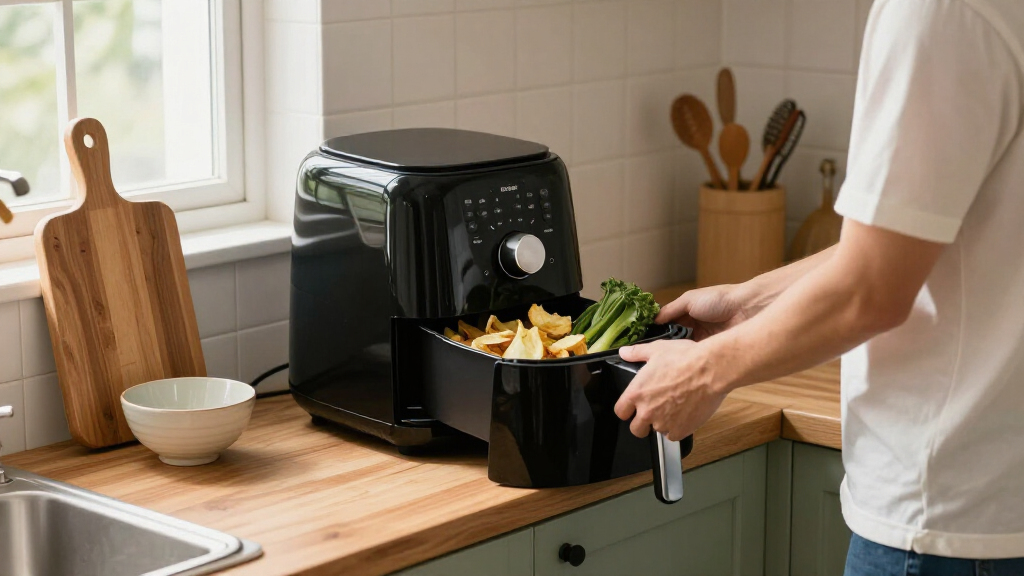
Air fryers for small kitchens usually come in compact basket designs or roomier oven-style designs. Basket models often use less counter space and feel simple to load, while oven-style models can add racks and handle a wider mix of tasks at the cost of a larger footprint. The practical difference is how you use that space: a basket gives food one main cooking area, while racks let you spread or separate foods but require room to open the door and remove trays safely.
| Feature | Basket model | Oven-style model |
|---|---|---|
| Counter footprint | Often smaller | Often larger |
| Cooking layout | One main basket | Racks or trays may offer more levels |
| Best fit | Small portions and simple meals | More room for varied tasks, if counter space allows |
| Tradeoff | Limited single-batch area | More space to store and clean |
Picture a renter with a narrow counter who mostly reheats pizza slices and cooks side dishes. A basket model may fit that routine better than an oven-style appliance with extra racks. A family cooking several separate foods may value those racks enough to give up more space, but multiple levels do not guarantee even results: food can shield food below it, so you may need to rotate trays or cook fewer items at once.
Dual baskets can let you cook two foods at different temperatures, but they take more counter width and add parts to wash. Viewing windows help you check browning without opening the unit, though they may make the appliance bulkier. App controls are useful only if remote settings fit your routine; otherwise they add cost and setup without improving the meal. Choose features around meals you already make, not a long preset list you may rarely touch.
Get crisp results from a compact basket
Air fryers for small kitchens can brown food well when hot air can move around each piece. A crowded basket traps steam and blocks airflow, so the outside may turn soft or patchy instead of crisp. This is why a smaller usable cooking area can matter more than a generous volume rating: spreading food out gives hot air access to more surfaces.
Use these simple habits for better texture:
- Leave gaps. Cook a smaller batch if the basket is packed shoulder to shoulder. The extra round takes time, but it often produces more even browning than piling food high.
- Dry fresh food. Pat wet vegetables or potato pieces with a clean towel before cooking. Surface water must evaporate before the food can brown, so starting drier helps it crisp sooner.
- Shake or turn halfway. That helps food brown across more surfaces, especially in a basket where the bottom and sides sit close to the food.
- Add a little oil when it helps. A light coating can improve browning on some fresh foods; many frozen products already contain oil. Extra oil is not a shortcut for overcrowding, which still limits airflow.
Say you load a full basket of damp zucchini slices. They may soften and steam against one another. Cook half at a time, leave space between pieces, and you are more likely to hear a faint crackle as their edges brown.
Cooking times can differ from package instructions written for conventional ovens because the cooking space and airflow differ. Check food as it cooks, and follow safe internal-temperature guidance for meat and poultry. Air-fried food is not automatically healthier; less added oil can help compared with deep-frying, but ingredients and portions still count.
Keep cleaning and daily use easy enough to stick with
Air fryers for small kitchens are easiest to live with when their removable parts clean simply and the appliance has a convenient, safe place to operate. Check whether the basket and crisper plate are dishwasher-safe, and see whether you can wipe the cooking chamber without awkwardly reaching past a heating element. Easy cleanup matters because grease and crumbs left behind can smoke, while a hard-to-clean design can turn a quick weeknight meal into a chore.
After cooking bacon or marinated food, grease and crumbs can collect in the basket or cooking area. Leftover residue may smoke the next time you switch the unit on, so let the appliance cool and clean it as the manufacturer directs. Avoid abrasive tools or soaking parts unless the manual says they are safe. If a coating is damaged by harsh scrubbing, food may stick more readily and cleanup can become harder over time.
Controls and sound matter, too. A simple dial may be easier to use than a screen full of presets, while fan noise can be noticeable in a small open-plan room. If you cook while someone takes a video call nearby, checking owner reviews for noise complaints may save a daily irritation. A quieter model may be worth a modest premium if you run it often, but it should still fit your cooking and storage needs.
Price is only one part of the choice. Compare warranty coverage and replacement-part availability alongside size and features, especially if you expect to use the appliance several times a week. A replaceable basket or crisper plate can extend the useful life of a model; limited parts support may make a low purchase price less attractive if a frequently used component wears out.
Decide whether it can replace your oven or cut energy use
An air fryer can replace some oven jobs for small portions, but it is not a full replacement for every kitchen. Its compact cooking space suits a quick side dish or a few leftovers; it may not handle a large tray, several dishes at once, or baking that depends on a particular pan and even heat. The choice is a tradeoff between heating a smaller space for a modest meal and keeping the oven for food that needs room, steady heat, or several portions at once.
For a single baked potato and two portions of vegetables, heating a smaller appliance may take less energy than heating a conventional oven. The actual difference depends on the appliance, food, portion, and cooking time. A microwave may be more practical for soup, while a toaster oven may suit a slice of bread better. Choosing the appliance suited to the job can matter more than relying on a general claim that one type always uses less electricity.
Recent models often add roasting, baking, dehydrating, and reheating modes. Those settings broaden the menu, but they do not automatically make a bulky appliance a good fit. More modes can mean extra controls and accessories to store, and they are valuable only if they replace tasks you already do. In a studio kitchen, a plain basket air fryer that you use three nights a week may serve you better than a feature-packed unit that lives in a cupboard.
Key point: Buy for the meals you make often, then check that the appliance fits safely when you use it—not just when it is stored.
Frequently Asked Questions
What size air fryer works best for a small kitchen?
Start with your usual portions and measure the appliance’s actual dimensions. A compact model works well for one or two people if its basket can cook your regular foods without too many batches.
Can an air fryer replace a regular oven?
It can handle many small meals, sides, and reheating jobs, but its capacity and shape limit what fits. A regular oven remains useful for large trays, multiple dishes, and some baking tasks.
How much clearance does an air fryer need?
Follow the ventilation and heat-clearance instructions in the model’s manual. Measure nearby cabinets before buying, and keep the intake and exhaust vents open while it runs.
Does an air fryer use less electricity than an oven?
It often uses less energy for small portions and quick cooking because it heats a smaller space. The difference depends on the appliance, recipe, serving size, and cooking time.
Why is food not getting crispy in my air fryer?
A crowded basket, wet food, or blocked airflow can leave food soft instead of browned. Pat fresh ingredients dry, leave room between pieces, shake or turn them, and cook in batches if needed.
Conclusion
Choose an air fryer that fits your counter safely and cooks the portions you actually eat. Measure first, compare usable basket area, and count only the features you will use.
Then leave the vents clear, give the basket room to breathe, and let the kitchen fill with the soft crackle of a meal that fits your evening—and your space.
Fall Picks
fall essentials
As an affiliate, we earn on qualifying purchases.