This guide shows you how to use an electric popcorn maker to produce a fresh batch of popcorn from raw kernels, safely and with as few unpopped kernels as possible. It covers the two most common machine types — hot-air poppers and stirred or motorized oil poppers — so you can follow the steps that match your model. You will learn how much corn and oil to use, when to stop the machine, how to avoid burnt popcorn, and how to clean the unit so it keeps working properly.

Get kitchen gear delivered free — and shop member deals
- Fast, free delivery on millions of items
- Access to Prime Big Deal Days deals on October 6–7
- Prime Video, Amazon Music and more included

West Bend Stir Crazy 6-Quart Hot Oil Popcorn Popper
- ✔ Capacity: 6 quarts
- ✔ Popping Method: Hot oil with motorized stirring rod
- ✔ Popping Time: About 4 minutes

Dash Fresh Pop Electric Hot Air Popcorn Maker
- ✔ Capacity: 16 cups per batch
- ✔ Popping Method: Hot air (no oil)
- ✔ Popping Time: About 3 minutes
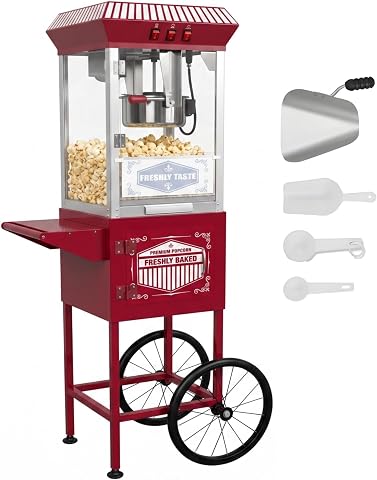
ZORVANTI 16oz Vintage Theater Style Popcorn Machine with Cart
- ✔ Capacity: Up to 72 cups per batch
- ✔ Kettle Size: 16 oz stainless steel with automatic stirrer
- ✔ Power: 850W
This is a beginner-level task. No cooking experience is required. Each batch takes roughly 10 to 15 minutes from setup to finished bowl, and cleanup adds about 10 minutes. If you have never used the machine before, read the Before You Start section carefully — most problems with popcorn makers come from small setup mistakes, not from the machine itself.
Difficulty: Beginner | Time: 10-15 minutes per batch, plus 10 minutes for cleaning
What You’ll Need
Tools & Materials:
- An electric popcorn maker (hot-air popper or oil popper with stirring rod)
- Fresh popcorn kernels (1/2 cup for a standard batch)
- Cooking oil if using an oil popper (coconut, canola, or sunflower oil work well)
- Salt or popcorn seasoning
- A large heat-safe bowl (at least 4-quart capacity for hot-air poppers)
- Oven mitts or a dry towel for handling hot parts
- Measuring cup
- Soft cloth or sponge and mild dish soap for cleaning
Knowledge:
- Basic kitchen safety around hot surfaces and steam
- Ability to plug in and switch on a small appliance
- Familiarity with your machine’s lid, chute, or cover mechanism
Check which type of machine you have before starting. Hot-air poppers have a chamber you pour kernels into and a chute that expels popped corn into a bowl; they use no oil. Oil poppers have a nonstick pot with a stirring rod and usually a domed lid with a butter-melting well on top. The steps differ slightly between the two, and each is labeled below. If you still have your machine’s manual, keep it nearby for model-specific quantities.
West Bend Stir Crazy 6-Quart Hot Oil Popcorn Popper
The West Bend Stir Crazy earns our top spot because it hits the sweet spot most buyers actually live in: big enough for a family, small enough for a cabinet, and flavorful enough to feel like a treat. Its motorized stirring rod with automatic reversal is the feature that separates it from cheap oil poppers and from the Dash alike — by keeping kernels moving across the triple-layer nonstick heating plate, it pops noticeably more of each batch and leaves fewer stubborn duds at the bottom.Where the Dash produces a light, dry base that begs for toppings, the Stir Crazy’s hot-oil method builds flavor into the popcorn itself. The vented clear cover doubles as a 6-quart serving bowl, and the integrated butter well melts butter over the popping corn as it works — a genuinely useful trick rather than a gimmick. The tradeoff is real, though: you have to flip the entire machine upside down to use the cover as a bowl, and hot-oil popping is inherently messier than air popping, with a heating plate that needs wiping after every use.Compared with the ZORVANTI, the Stir Crazy gives up an enormous amount of capacity — 6 quarts versus 72 cups — but it also gives up the floor space, the price, and the cleanup burden of a concession-style cart. For a household that makes popcorn weekly rather than hosting quarterly events, this balance is why it leads our ranking.
Pros:
- Motorized stirring rod with automatic reversal pops more kernels per batch
- Cover doubles as a 6-quart serving bowl with an integrated butter melting well
- Triple-layer nonstick heating plate wipes clean quickly
- Compact nesting design with cord wrap stores easily in a cabinet
Cons:
- Must be flipped upside down to invert the cover into a serving bowl
- Hot oil popping is messier than air popping and requires oil cleanup
- BPA-free plastic housing feels less premium than glass and steel alternatives
Best for: Families and frequent popcorn makers who want oil-popped flavor and high kernel yield without concession-stand equipment
Not ideal for: Buyers prioritizing oil-free snacking or those unwilling to wipe down a hot oil plate after each batch
Bottom line: The most balanced pick here — stirring-rod kernel yield, family-size batches, and bowl-lid convenience make it the right default for most households.
“The most balanced pick here — stirring-rod kernel yield, family-size batches, and bowl-lid convenience make it the right default for most households.”
Dash Fresh Pop Electric Hot Air Popcorn Maker
If your priority is a fast, oil-free snack rather than maximum flavor or volume, the Dash Fresh Pop is the obvious choice. It pops up to 16 cups in about three minutes using nothing but 1400W of forced hot air — no oil, no stirring, no nonstick plate to scrub. That makes it the lightest option here by a wide margin, both calorically and in terms of daily effort.Its cleverest touch is the measuring cup that doubles as a butter melting tray, riding the machine’s heat to melt toppings while the corn pops. The compact footprint and cheerful Aqua finish (among other colors) mean it earns counter space rather than fighting for it — a genuine advantage over the West Bend if your kitchen is tight or your popcorn habit is a solo one. The included recipe guide nudges you toward sweet and savory variations, which matters more than it sounds: air-popped corn is a blank canvas, and you’ll want toppings to match the flavor the Stir Crazy gets from oil alone.The tradeoffs are structural. Air popping sends some kernels flying out of the chute, and hand-washing the top cover and measuring cup is a small recurring annoyance. Compared with the ZORVANTI, the Dash is playing an entirely different game — it’s a personal snacking appliance, not an event machine. That focus is precisely why it earns its place rather than ranking last on raw capability.
Pros:
- Hot air popping requires no oil for a lighter snack
- 16 cups in about 3 minutes — the fastest batch in this lineup
- Measuring cup doubles as a butter melting tray
- Compact, colorful design earns permanent counter space
Cons:
- Top cover and measuring cup require hand washing
- Air-popped corn is blander and depends heavily on toppings
- Smaller effective serving size than the oil machines in this comparison
Best for: Solo snackers, small households, and health-focused buyers who want oil-free popcorn in minutes with minimal cleanup
Not ideal for: Large families, party hosts, or anyone who expects rich oil-popped flavor straight from the machine
Bottom line: The pick for health-conscious, space-limited buyers — fastest and lightest, as long as you accept a plainer base flavor.
“The pick for health-conscious, space-limited buyers — fastest and lightest, as long as you accept a plainer base flavor.”
ZORVANTI 16oz Vintage Theater Style Popcorn Machine with Cart
The ZORVANTI vintage theater-style machine is the enthusiast’s answer, and we ranked it third only because most buyers don’t need what it offers — not because it’s weak. Its 850W stainless-steel 16-ounce kettle with an automatic stirrer produces up to 72 cups per batch, roughly twelve times the Dash’s output and several times the Stir Crazy’s. If you’re running a concession stand, a fundraiser, or a serious home theater night, nothing else here comes close.The details are what justify the premium role: three independent switches let you control the warming light, stirrer, and kettle heater separately — so the warming deck keeps earlier batches serving-hot while you pop the next one. Tempered safety glass and ETL Listed certification matter more at this power level, and the wheeled cart with built-in storage means the machine is genuinely mobile rather than a fixture you’ll resent. The removable kettle and kernel tray keep cleanup from becoming the ordeal it is on many concession machines.Be clear-eyed about the downsides. This is a piece of furniture, not an appliance you stow away, and it’s massive overkill for a Tuesday-night snack for two. Its track record is also thinner than the West Bend’s established reputation, so you’re accepting some early-adopter risk. Buy it because you host; skip it if you don’t.
Pros:
- Up to 72 cups per batch — event-scale output the others can’t approach
- Removable stainless-steel kettle and kernel tray simplify cleaning
- Independent switches for warming light, stirrer, and kettle heater
- Mobile wheeled cart with built-in storage cabinet
Cons:
- Large footprint means it lives on the floor permanently, not in a cabinet
- Far more machine than a typical household needs for everyday snacking
- Newer model with a shorter market track record than established competitors
Best for: Home theater owners, event hosts, and small concession operations needing 70+ cups per batch with theatrical presentation
Not ideal for: Small households or anyone without the floor space and regular entertaining need to justify it
Bottom line: A justified splurge for entertainers — unmatched capacity and theater-style presentation, provided you host often enough to earn its floor space.
“A justified splurge for entertainers — unmatched capacity and theater-style presentation, provided you host often enough to earn its floor space.”
As an Amazon Associate we earn from qualifying purchases.
Before You Start
Place the machine on a flat, dry, heat-resistant surface away from the edge of the counter, with at least 30 cm (12 inches) of clearance above and beside it. Hot-air poppers blow steam and can launch stray kernels; oil poppers get hot on the outside. Keep the power cord away from the front of the machine and away from water.
Use fresh kernels. Popcorn pops because moisture inside each kernel turns to steam and bursts the hull. Kernels that are old or have been stored open in dry air lose that moisture and fail to pop. Buy kernels with a recent packing date and store them in an airtight jar. If more than a quarter of your kernels stay unpopped, stale corn is the most likely cause.
Measure everything before you switch anything on. Popcorn moves fast — from first pop to finished batch is often under three minutes — and you will not have time to measure or fetch a bowl mid-cycle.
Never operate a hot-air popper without kernels in it, and never run any popper longer than about 4 to 5 minutes continuously, as this can overheat the element.
Step-by-Step Instructions
Step 1: Position the machine and set out your bowl
Set the popcorn maker on a clear, level, heat-safe surface. Place your large bowl directly in front of the popping chute if you have a hot-air popper, so popped corn lands inside it. If you have an oil popper with a lid that flips or a pot that inverts for serving, clear space for that motion now.
Tip: Put a tray or paper towel under the bowl area. A few kernels always escape, and this makes cleanup a ten-second job instead of a floor hunt.
Check: The machine sits level, cannot be knocked easily, the cord reaches the outlet without stretching, and your bowl is positioned to catch the output.
Step 2: Measure the kernels and oil
Measure 1/2 cup (about 90 g) of popcorn kernels for a standard batch. If you have an oil popper, add the oil recommended in your manual — typically 1 to 2 tablespoons — directly into the pot. Most oil poppers have a fill line or a mark inside the pot; do not exceed it.
Tip: For hot-air poppers, do not add oil to the popping chamber — oil in a hot-air machine damages the heating element and voids most warranties. Oil goes on the popcorn after popping, not before.
Check: You have 1/2 cup of kernels ready, and for an oil popper, the correct amount of oil is already in the pot.
Step 3: Load the machine
For a hot-air popper: pour the kernels into the popping chamber, attach the lid, and place the measuring cup (most models double as one) into its slot on top if applicable. For an oil popper: add the kernels into the pot with the oil, then fit the lid securely and, if your model has one, place butter in the melting well on top of the lid.
Tip: If you want buttered popcorn on a hot-air machine, put 1 to 2 tablespoons of butter in the top melting cup now if your model includes one; otherwise melt butter separately in the microwave while the machine runs.
Check: The lid is seated firmly with no gaps, and all kernels are inside the chamber or pot — none lodged in the chute or under the lid.
Step 4: Plug in and switch on
Plug the machine into a wall outlet — avoid sharing the outlet with a kettle or microwave, since poppers draw significant power. Switch the machine on. On most hot-air poppers, the fan and heater start immediately; on oil poppers, the stirring rod will begin rotating.
Tip: Stand by the machine for the entire cycle. Do not walk away — the batch finishes in 2 to 4 minutes and can scorch quickly at the end.
Check: You hear the fan running (hot-air models) or the stirring rod turning (oil models) within a few seconds.
Step 5: Watch the popping cycle
Let the machine run. Popping typically begins 1 to 2 minutes after startup. On a hot-air popper, popped corn will start flowing out of the chute into your bowl — hold or nudge the bowl to keep it centered if needed. On an oil popper, watch through the lid window as the kernels expand and fill the dome.
Tip: On a hot-air popper, the first kernels to emerge can fly out energetically. Keep hands and face clear of the chute, and steady the bowl rather than holding it directly under fast-moving corn.
Check: Popped corn is collecting steadily in your bowl or filling the pot, and popping sounds are coming rapidly.
Step 6: Stop the machine at the right moment
Listen to the popping rate. When pops slow to 2 to 3 seconds apart, switch the machine off. For hot-air poppers, wait a few extra seconds for the last kernels to clear the chute. For oil poppers, switch off immediately when popping slows to prevent the bottom layer from scorching.
Tip: Do not wait for total silence — you will burn the batch. A few unpopped kernels left in the machine is normal and correct.
Check: The machine is off, the popping has stopped, and your bowl is full of light, pale-golden popcorn with only a small handful of unpopped kernels at the bottom.
Step 7: Season and serve
Transfer the popcorn to a serving bowl if needed. If you melted butter in the lid well or a microwave, drizzle it over the popcorn while tossing gently with a spoon so it coats evenly. Sprinkle salt or seasoning while tossing — fine popcorn salt sticks far better than coarse salt.
Tip: Season in two or three additions with tossing between each, rather than all at once. This gives even coverage without soggy spots.
Check: The popcorn is coated lightly and evenly, and a taste test shows seasoned, crunchy popcorn with no burnt pieces.
Step 8: Let the machine cool, then clean it
Unplug the machine and let it cool for at least 15 minutes before touching any internal parts. Once cool, wipe the popping chamber, lid, and chute with a soft, slightly damp cloth and mild dish soap. For oil poppers, wash the nonstick pot and stirring rod per your manual — most removable parts are hand-wash only. Dry all parts fully before reassembling.
Tip: Never immerse the base of the machine in water — it contains the motor and heating element. Only removable, detachable parts can be washed, and only as your manual directs.
Check: All parts are dry, free of oil residue and kernel fragments, and the machine is reassembled and stored or ready for the next batch.
Common Mistakes to Avoid
- Overfilling the popping chamber or pot — Stick to 1/2 cup of kernels, or the quantity in your manual. Overfilled machines overflow, spill kernels, and leave large amounts of unpopped corn because kernels need room to expand.
- Running the machine after popping stops — Switch off when pops are 2 to 3 seconds apart. The last seconds of a cycle are where burning happens, and burnt popcorn both ruins the batch and leaves a smell that clings to the machine.
- Adding oil to a hot-air popper — Hot-air machines pop with heated air only. Oil in the chamber damages the element. Add oil or butter to the finished popcorn instead, or use the butter-melting cup if your model has one.
- Using stale kernels — Store kernels in an airtight container and buy in quantities you will use within a few months. If many kernels fail to pop, the corn has dried out — replace it rather than blaming the machine.
Troubleshooting
Problem: Many kernels fail to pop
Solution: First check kernel freshness — stale corn is the most common cause. If the kernels are fresh, the machine may be shutting off too early; let it run until pops are 2 to 3 seconds apart. In very cold kitchens, chilled kernels pop poorly, so store corn at room temperature.
Problem: Popcorn tastes burnt
Solution: You are running the cycle too long. Switch off as soon as popping slows to every 2 to 3 seconds. On oil poppers, also verify you are using enough oil — dry kernels against a hot surface scorch quickly. Clean any burnt residue from the pot before the next batch, as it transfers flavor.
Problem: Popped corn flies out of the bowl or chute (hot-air models)
Solution: Use a bigger bowl — at least 4 quarts — and position it so the chute opening sits partly inside the bowl rim. Hold the bowl slightly tilted toward the chute so kernels bounce off the near wall and settle.
Problem: The machine will not turn on
Solution: Check that the plug is fully seated in a working outlet, and test the outlet with another appliance. Some models have a thermal cutoff that trips if the machine overheats; if so, unplug it and let it cool for 20 to 30 minutes, then try again. If it still does not run, contact the manufacturer.
What Success Looks Like
A successful batch looks like this: a large bowl of light, crisp popcorn with a pale golden color, only a small number of unpopped kernels (under about 10 percent of what you loaded), no black or dark-brown pieces, and even seasoning throughout. The machine should be unplugged, fully cooled, cleaned, and dry before storage. If you achieved all of this on your first batch, the technique is correct — subsequent batches are simply repetition.
Next Steps
Once you can run a reliable basic batch, adjust to taste. Try different oils in an oil popper — coconut oil gives a classic cinema flavor. Experiment with seasonings such as nutritional yeast, smoked paprika, or cinnamon sugar, adding them while the popcorn is still warm so they adhere. If you pop frequently, mark the exact kernel and oil quantities that worked for your machine on a label and keep it with the unit. Clean the machine after every oily batch and inspect the stirring rod and cord periodically for wear. If popping performance steadily declines despite fresh kernels, the heating element may be aging — at that point, compare repair options against replacing the unit.
Frequently Asked Questions
How much popcorn does 1/2 cup of kernels make?
Half a cup of kernels produces roughly 4 quarts (about 15 cups) of popped corn — enough for 2 to 3 people. Hot-air poppers are usually designed around exactly this quantity, so increasing it beyond 1/2 cup tends to cause overflow and unpopped kernels.
Can I add sugar to make kettle corn in the machine?
Only in an oil popper, and only with care — add sugar partway through the cycle when kernels are mostly popped, as sugar burns faster than corn. Never put sugar in a hot-air popper; it melts onto the element and is very difficult to clean. Kettle corn is easier and safer to finish in a stovetop pan.
Why is my popcorn chewy instead of crunchy?
Chewy popcorn usually means trapped steam. For hot-air popping, transfer the corn out of the hot bowl immediately and let steam escape while tossing. Avoid covering the bowl right after popping, and let butter-coated corn air for a minute before serving.
How often should I clean the popcorn maker?
Wipe the chamber, lid, and chute after every use. Oil poppers need the pot washed after every batch, since residue builds up and scorches. A hot-air popper used without oil needs only a dry or lightly damp wipe plus removal of stray kernels.
Can I put the parts in the dishwasher?
It depends on the model. Some oil-popper lids and pots are dishwasher-safe, but most manufacturers recommend hand-washing to protect nonstick coatings. Never put the machine base in water or the dishwasher. Check your manual before washing any removable part mechanically.
Fall Picks
fall essentials
As an affiliate, we earn on qualifying purchases.