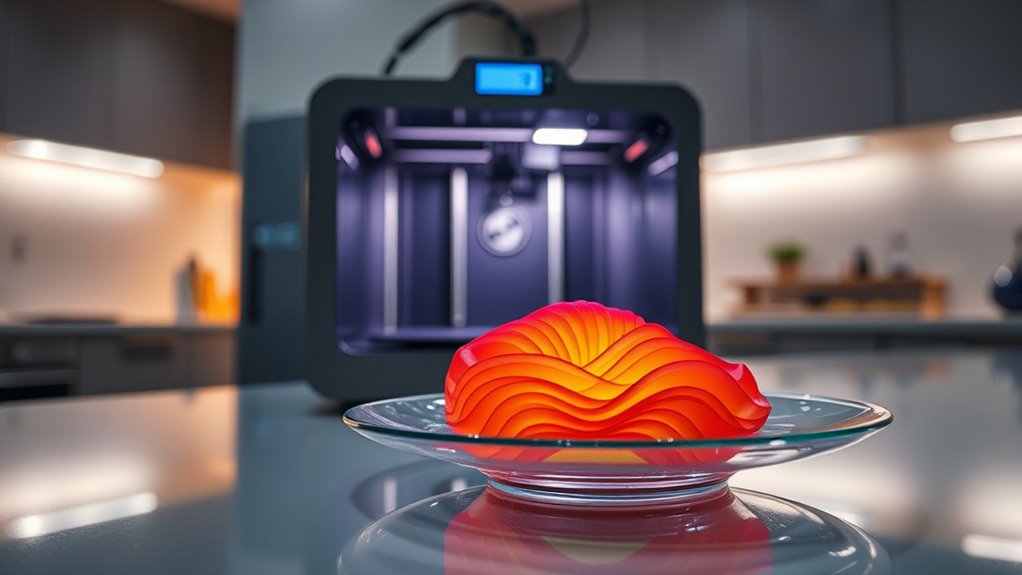

3D food printing is shaping the future of cooking by letting you create personalized, sustainable, and visually stunning meals. With this technology, you can craft intricate shapes, textures, and custom flavors that meet your dietary needs, reducing waste and supporting eco-friendly practices. It opens new possibilities for both home cooks and professionals to push culinary boundaries while promoting healthier, environmentally conscious eating. If you keep exploring, you’ll uncover more about how this innovative method is transforming the way we enjoy food.
Key Takeaways
- 3D food printing enables personalized, visually appealing dishes with complex shapes and textures beyond traditional cooking methods.
- It promotes sustainability by using eco-friendly ingredients and reducing food waste through precise portioning.
- The technology allows customization of flavors, nutritional content, and dietary needs for individual preferences.
- 3D printing enhances efficiency in meal preparation, supporting quick adaptation for various nutritional and aesthetic requirements.
- As a culinary innovation, it fosters creative and sustainable eating experiences, shaping the future of personalized cuisine.

3D food printing is revolutionizing the way we prepare and enjoy meals by combining technology with culinary creativity. With this innovative approach, you can now craft dishes that are not only visually stunning but also aligned with sustainability goals. One of the key advantages of 3D printing in food is the ability to utilize sustainable ingredients. Instead of relying on conventional supply chains, you can incorporate locally sourced, plant-based, or even lab-grown proteins into your meals. This reduces environmental impact, minimizes waste, and promotes responsible consumption. By choosing sustainable ingredients, you contribute to a healthier planet while still enjoying delicious, personalized food.
The customization options available through 3D food printing are truly game-changing. You have the power to tailor each meal to your specific dietary preferences, nutritional needs, or aesthetic desires. Want a dessert with intricate patterns or a snack shaped precisely to fit your hand? The technology makes it possible. You can adjust flavors, textures, and ingredient combinations on the fly, creating a truly bespoke dining experience. This level of customization is perfect for households with unique dietary restrictions or health goals, as you can easily modify recipes without sacrificing taste or presentation. It also opens new doors for chefs and food enthusiasts enthusiastic to push culinary boundaries and experiment with new ideas.
Imagine being able to select your ingredients digitally and watch as the printer layers them into a perfect design. This process reduces waste because you only use what’s necessary for each portion. Plus, you can prepare multiple meals with different nutritional profiles simultaneously, making it efficient for busy households or commercial settings. Additionally, 3D food printing can incorporate functional ingredients, such as vitamins or probiotics, into your meals seamlessly, enhancing their health benefits. The technology encourages creativity by enabling the creation of complex shapes and textures that traditional cooking might find difficult or impossible to achieve. Whether it’s a geometrically intricate appetizer or a personalized protein mold, the possibilities are expansive.
Furthermore, understanding passive voice detection can improve the clarity and engagement of your writing, making your content more effective and accessible. As you explore 3D food printing, you’ll notice that it’s not just about novelty—it’s about transforming the way we think about sustainable eating, personalization, and culinary innovation. By embracing this technology, you’re helping shape a future where meals are more environmentally friendly, tailored to individual needs, and limited only by your imagination. This fusion of tech and cuisine doesn’t just change how you eat; it changes how you think about food itself.
As an affiliate, we earn on qualifying purchases.
Frequently Asked Questions
How Does 3D Food Printing Impact Traditional Culinary Arts?
You might find that 3D food printing impacts traditional culinary arts by blending cultural preservation with culinary innovation. It allows you to recreate authentic flavors while experimenting with new textures and presentations, transforming how you approach cooking. This technology challenges conventional methods, encouraging you to think creatively and preserve cultural dishes in modern ways. Embracing 3D printing can enhance your culinary repertoire, making meals more personalized, efficient, and innovative.
Are 3D Printed Foods Nutritionally Equivalent to Conventional Meals?
You’ll find that 3D printed foods can be nutritionally equivalent to traditional meals when designed carefully, ensuring proper nutritional balance. Manufacturers use advanced techniques to optimize ingredients for health and safety, maintaining food safety standards. However, the technology’s success depends on precise formulation and quality control. As a result, 3D printed foods can meet your nutritional needs while offering innovative culinary experiences, provided they adhere to strict safety and nutritional guidelines.
What Are the Environmental Benefits of 3D Food Printing?
You’ll find that 3D food printing truly hits the sweet spot for sustainability benefits. It markedly reduces waste by using precise ingredient amounts and allows for customized portions, cutting down excess. Plus, it promotes eco-friendly practices by utilizing alternative ingredients and minimizing resource use. This technology helps you make a positive impact on the environment while enjoying innovative meals, proving that sometimes, a little change can go a long way.
How Accessible Is 3D Food Printing Technology Worldwide?
You might find 3D food printing technology varies in accessibility worldwide. High cost barriers limit adoption in many regions, making it less available outside tech hubs or affluent areas. Regional availability depends on local investments, infrastructure, and interest in innovative cooking methods. While some countries embrace this innovation, others face challenges due to cost and resource constraints, so widespread accessibility still has a way to go.
Can 3D Food Printers Replicate Complex Flavors and Textures?
You can’t expect a 3D food printer to perfectly mimic every intricate flavor and texture yet. While it excels at patterning and basic flavor layers, capturing complex flavor profiles and delicate textures remains a challenge, like trying to paint a masterpiece with broad strokes. Advances in ingredient blending and precision extrusion are improving flavor complexity and texture replication, but for now, some culinary artistry still needs a human touch.
personalized food 3D printing kit
As an affiliate, we earn on qualifying purchases.
As an affiliate, we earn on qualifying purchases.
Conclusion
While some worry 3D food printing might replace traditional cooking, it actually enhances creativity and accessibility in the kitchen. Imagine customizing meals to your dietary needs or experimenting with new flavors effortlessly. It’s not about replacing chefs but empowering them and home cooks alike. Embracing this technology means opening doors to healthier, sustainable, and personalized eating experiences. So, don’t fear the future of food—welcome it as a tool to enrich your culinary journey.
sustainable food ingredients for 3D printing
As an affiliate, we earn on qualifying purchases.
As an affiliate, we earn on qualifying purchases.
3D printed food molds and shapes
As an affiliate, we earn on qualifying purchases.
As an affiliate, we earn on qualifying purchases.