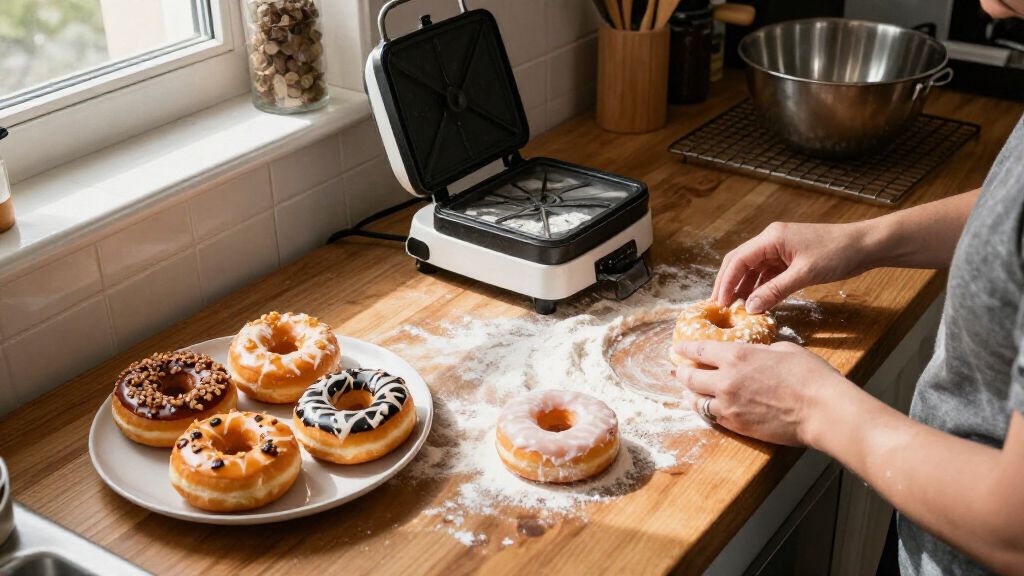
Specialty donut makers range from compact presses for occasional treats to multi-row machines built for larger batches. I rank the FOHERE Commercial Automatic 4-Row Mini Donut Maker as the best overall for its higher-volume format, while the JOVELL 16-Hole Mini Donut Maker stands out for its included accessories and the Dash Mini Donut Maker for its seven-donut batch size. The main tradeoff is capacity versus counter space and simplicity: larger machines can suit frequent batches, while small countertop models take up less room. Coating type, cavity count, and included tools also shape how much hands-on work each option asks of you. Read on for the full comparison and guidance on choosing a donut maker that matches your kitchen and baking habits.

Get kitchen gear delivered free with Prime
- Fast, free delivery on millions of items
- Prime Video, Amazon Music and more included
- Member-only deals all year
Complete the kit



Key Takeaways
- The FOHERE’s four-row format sets it apart for buyers prioritizing batch capacity over a small footprint.
- JOVELL combines 16 cavities with an oil brush and oven gloves, so its appeal comes from both batch size and a more complete accessory package.
- Seven-donut models such as the Dash Mini and Dash Express sit between compact six-donut designs and higher-capacity machines, offering a middle ground for casual batches.
- The lineup includes several Baker’s Friend and DSP variants; compare cavity counts and included accessories rather than assuming products from the same brand are interchangeable.
- The AshGlen ceramic-coated eight-cavity pan is a distinct alternative to countertop appliances, while the Norpro Donut Maker is the lineup’s manual-style option.


| specialty donut maker | Brand | Capacity | Model | Dimensions |
|---|---|---|---|---|
| FOHERE Commercial Automatic 4- | FOHERE | — | ZDT-4 | 21.85 × 14.76 × 14.57 inches |
| JOVELL 16-Hole Mini Donut Make | JOVELL | 16 mini-donut holes | DD | 13.3 × 11.4 × 13.3 inches |
| Ht Viik Mini Donut Maker | Ht Viik | 2 donuts | — | 8.66 × 2.7 × 8.66 inches |
| Norpro Donut Maker | Norpro | 2 cups (16 oz / 480 ml) | 3168 | 7 × 4 × 4 inches |
| Baker’s Friend Mini Donut Make | Baker’s Friend | 12 mini doughnuts | BF-DM01G | — |
| Dash Mini Donut Maker | Dash | 7 mini donuts per batch | DDM007GBDP04 | — |
| Baker’s Friend Mini Donut Make | Baker’s Friend | 6 donuts | BF-6DM01 | 11.2 × 4.3 × 10 inches |
| Baker’s Friend Mini Donut Make | — | 12 mini doughnuts | BF-DM01 | 12 × 11 × 2.75 inches |
| DSP Mini Donut Maker | DSP | 6 donuts | Mini Donut Maker | 9 × 2.8 × 8.3 inches |
| AshGlen 2" Mini Donut Maker | AshGlen | 8 donuts | AG-PMDM01G | 8.7 × 8.7 × 3.5 inches |
| Dash Express Mini Donut Maker | Dash | 7 mini donuts per batch | — | — |
| DSP Mini Donut Maker with Acce | — | — | — | — |
More Details on Our Top Picks
FOHERE Commercial Automatic 4-Row Mini Donut Maker
For a café, concession stand, or event kitchen that needs a steady stream of mini donuts, the FOHERE Commercial Automatic 4-Row is in a different class from countertop batch makers. It automates forming, frying, flipping, counting, and output, with stated production of up to 250 donuts per hour. That workflow can save hands-on time compared with the JOVELL 16-Hole Mini Donut Maker, which bakes a batch at a time rather than handling a continuous frying process. The tradeoff is a larger, heavier machine that needs oil in its tank and a suitable commercial workspace; it is not a casual home-kitchen substitute. Temperature control and overheating protection add useful operating safeguards, while stainless steel suits a work setting. I’d choose it for throughput, not versatility or compact storage.
Pros:- Automates forming, frying, flipping, counting, and output
- Rated to produce up to 250 mini donuts per hour
- Temperature control and overheating protection are included
- Stainless steel construction and removable parts support cleaning
Cons:- Requires oil in the tank before operation
- At 35.2 pounds and over 21 inches long, it is bulky for a home kitchen
- Its commercial frying workflow is less suited to small, occasional batches
Best for: Cafés, food stalls, and event operators who need automated mini-donut production and have space for commercial equipment.
Not ideal for: Home bakers with limited counter or storage space, or anyone seeking an oil-free appliance for occasional batches.
- Brand:FOHERE
- Model:ZDT-4
- Power:1750 watts
- Hopper capacity:3 L
- Donut rows and size:4 rows; 40 mm molds
- Production capacity:Up to 250 donuts per hour
- Dimensions:21.85 × 14.76 × 14.57 inches
- Weight and material:35.2 pounds; stainless steel
Our verdict“Choose the FOHERE when commercial throughput and automated frying matter more than a compact footprint or simple home use.”
JOVELL 16-Hole Mini Donut Maker with Non-Stick Surface, Oven Gloves, and Oil Brush
The JOVELL suits home bakers who want to make a batch of mini donuts quickly without managing a fryer. Its 16-hole layout gives it more batch capacity than the Ht Viik Mini Donut Maker, which bakes just two at a time, and double-sided heating is designed to cook both sides without manual turning. The stated cooking window of 1–5 minutes per batch makes it practical for family treats or small gatherings, while the oil brush and mini oven gloves add useful basics to the package. The compromise is size: these are small, roughly two-inch donuts, not full-size bakery-style rings. Its plastic housing may also feel less suited to frequent heavy use than the FOHERE’s stainless-steel commercial build. I’d pick JOVELL for convenient home batches, not high-volume service.
Pros:- Bakes up to 16 mini donuts in one batch
- Double-sided heating cooks both sides without manual flipping
- Stated cooking time is 1–5 minutes per batch
- Includes an oil brush and mini oven gloves
Cons:- Makes mini donuts only, with holes measuring about 1.97 inches
- Plastic housing may be less durable than the FOHERE’s stainless-steel construction
- Its batch-baking approach is slower for sustained high-volume production than an automatic commercial machine
Best for: Families and home bakers who want quick batches of mini donuts and value included handling accessories.
Not ideal for: Buyers who need full-size donuts, commercial throughput, or a metal-bodied appliance for frequent heavy use.
- Brand:JOVELL
- Model:DD
- Power:1400 W
- Capacity:16 mini-donut holes
- Hole diameter:1.97 inches (5 cm)
- Cooking time:1–5 minutes per batch
- Dimensions:13.3 × 11.4 × 13.3 inches
- Included components:Donut maker, oil brush, mini oven gloves, user’s guide
Our verdict“Choose JOVELL for quick, larger home batches of mini donuts, but skip it if you need full-size treats or commercial output.”
Ht Viik Mini Donut Maker
The Ht Viik is the most compact electric option here for someone who wants freshly baked donuts without giving much counter space to a specialty appliance. Its two-donut capacity is far below the JOVELL’s 16 holes and Baker’s Friend’s 12, so it makes more sense for a couple of portions or a small test batch than a party. Double-sided heating and cast aluminum plates are intended to cook the donuts evenly, and the PFOA-free non-stick surface, oil brush, and scraper keep preparation and cleanup straightforward. That compact format comes with practical cautions: the unit gets very hot during and after use, and the panel connection may feel loose. Compared with the Norpro dispenser, this is a self-contained electric baker, but it gives up Norpro’s ability to portion batter for other cooking surfaces.
Pros:- Compact dimensions suit kitchens with limited storage
- Double-sided heating and cast aluminum plates are designed for even baking
- PFOA-free non-stick coating helps with release and cleanup
- Includes an oil brush and scraper
Cons:- Makes only two donuts per batch, much fewer than the JOVELL or Baker’s Friend 12-count maker
- The unit gets very hot during and after use, requiring careful handling
- The loose-feeling panel connection may concern buyers expecting a rigid fit
Best for: Apartment cooks or occasional bakers who prioritize a small appliance and only need a couple of mini donuts at a time.
Not ideal for: Families making treats for groups, or anyone who wants larger batches, cool-touch handling, or a batter tool usable with multiple cooking surfaces.
- Brand:Ht Viik
- Wattage:750 watts
- Voltage:110 volts
- Capacity:2 donuts
- Plate material:Cast aluminum
- Coating:PFOA-free non-stick
- Dimensions:8.66 × 2.7 × 8.66 inches
- Included components:Donut machine, oil brush, scraper
Our verdict“Choose Ht Viik when compact storage matters more than batch capacity, and plan for careful handling around its hot surfaces.”
Norpro Donut Maker
The Norpro is not an electric donut cooker; it is a two-cup batter dispenser for shaping portions over hot oil, griddles, or waffle irons. That distinction makes it the most flexible pick for cooks who want to try old-fashioned donuts, donut holes, zeppoles, funnel cakes, churros, pancakes, or waffles with one tool. Compared with Baker’s Friend’s 12-donut electric maker, Norpro doesn’t limit you to a fixed mini-donut plate, but it also won’t heat or cook anything for you. The plunger is designed to dispense uniform circles, and the 16-ounce capacity reduces refills during a batch. The tradeoff is extra hands-on cooking and hand washing, unlike the JOVELL’s enclosed non-stick baking setup. I’d choose this for adaptable batter portioning, not push-button convenience.
Pros:- Works with hot oil, waffle irons, and griddles rather than a single fixed cooking surface
- Can portion batter for donuts, churros, funnel cakes, pancakes, and waffles
- Two-cup capacity helps reduce refill interruptions
- Includes instructions and recipes
Cons:- Does not heat or cook batter; cooking equipment is required
- Hand washing is recommended
- Requires more hands-on work than the JOVELL’s enclosed electric donut maker
Best for: Cooks who make several batter-based foods and want one dispenser for donuts, funnel cakes, pancakes, waffles, and similar recipes.
Not ideal for: Buyers seeking an electric appliance that cooks donuts automatically or a low-effort, dishwasher-cleanup solution.
- Brand:Norpro
- Model:3168
- Capacity:2 cups (16 oz / 480 ml)
- Dimensions:7 × 4 × 4 inches
- Operation:Plunger-style batter dispenser
- Compatible cooking surfaces:Hot oil, waffle irons, and griddles
- Care:Hand washing recommended
- Included items:Instructions and recipes
Our verdict“Choose Norpro if you value one batter dispenser for many recipes more than the convenience of an electric donut maker.”
Baker’s Friend Mini Donut Maker, Makes 12 Mini Doughnuts, Graphite
The Baker’s Friend 12-count model takes a middle path between the JOVELL’s 16-hole plate and Ht Viik’s two-donut format. Its 12 mini-donut capacity gives a household a useful batch without stepping up to the JOVELL’s larger listed footprint, while double-sided, PFOA-free non-stick surfaces are designed to cook evenly and release the donuts with less cleanup. The maker accepts cake, brownie, or other batter, so it offers more recipe latitude than a device limited to a single mix. A brush and recipe booklet help new owners get started. The tradeoff is that it remains a mini-donut appliance: Norpro can portion batter for many foods and cooking surfaces, while this model is tied to its electric plates. I’d pick it for straightforward home batches, not full-size donuts or commercial service.
Pros:- Makes 12 mini donuts per batch
- Double-sided non-stick plates support even cooking and easier release
- PFOA-free coating simplifies cleanup
- Includes a brush and recipe booklet
Cons:- Limited to mini donuts, unlike the Norpro dispenser’s range of batter-based foods
- Batch capacity is smaller than JOVELL’s 16-hole maker
- Not designed for the automated, high-volume production offered by the FOHERE
Best for: Home bakers who want a 12-piece mini-donut batch, a compact appliance, and room to use cake or brownie batter.
Not ideal for: Buyers who need full-size donuts, multiple cooking methods, or the high throughput of the FOHERE commercial machine.
- Brand:Baker’s Friend
- Model:BF-DM01G
- Capacity:12 mini doughnuts
- Coating:Double-sided, PFOA-free non-stick
- Materials:Metal and plastic
- Color:Graphite
- Included components:Brush and recipe booklet
- Batter options:Cake, brownie, and other batter
Our verdict“Choose Baker’s Friend for a practical 12-donut home batch; pick JOVELL for more pieces per batch or Norpro for broader cooking flexibility.”
Dash Mini Donut Maker – makes 7 mini donuts, non‑stick surface
The Dash Mini Donut Maker is a straightforward choice for families who want small batches and simple operation. It bakes seven mini donuts at once, one more than the DSP model’s six, while its 760-watt design keeps the appliance compact for a dorm, RV, or crowded counter. The batter-pour format gives kids a manageable way to help, though an adult will still need to handle the hot appliance. Dual non-stick surfaces make release and cleanup easier, but the fixed cooking setup offers no temperature or browning control. Compared with the Baker’s Friend 12-donut maker, this Dash prioritizes a smaller footprint over batch output. Choose it for casual, hands-on baking; skip it if you want larger donuts or more control over the finish.
Pros:- Makes seven mini donuts per batch, more than the six-cavity DSP model.
- Dual non-stick surfaces help donuts release and simplify cleanup.
- Compact design suits dorms, RVs, and kitchens with limited storage.
- Simple batter-pour operation is approachable for family baking.
Cons:- Only produces mini-size donuts.
- No adjustable temperature or browning settings.
- Seven-donut capacity is smaller than the 12-donut Baker’s Friend model.
Best for: Families with children who want a compact appliance for making small batches of mini donuts together.
Not ideal for: Bakers who want adjustable browning or full-size donuts, since this model only makes mini donuts and has no temperature settings.
- Brand:Dash
- Model:DDM007GBDP04
- Power:760 watts
- Capacity:7 mini donuts per batch
- Cooking surface:Dual non-stick surfaces
- Design:Compact, space-saving
- Warranty:1-year manufacturer warranty
Our verdict“Choose the Dash for easy, family-friendly mini-donut batches in a small kitchen, but pick a higher-capacity model for fewer repeat rounds.”
Baker’s Friend Mini Donut Maker, 6 Donuts, Aqua
The Baker’s Friend Mini Donut Maker favors donut size over batch count: it bakes six 3-inch donuts, giving each serving more presence than the bite-sized output of the brand’s 12-cavity model. Power and readiness indicator lights make it easier to tell when the appliance is on and ready, a helpful cue for new users, while the included recipe booklet and brush give beginners a starting point for batter and cleanup. Its 1,000-watt rating is higher than the Dash model’s 760 watts, but the unit still has just one cooking setting, so it cannot tailor browning to different batters. The 120-volt requirement also limits where it can be used. Pick this one for more substantial portions, not maximum throughput or fine control.
Pros:- Makes six 3-inch donuts, larger than the bite-sized output of 12-cavity models.
- Power and readiness lights provide clear operating cues.
- Includes a brush and recipe booklet for getting started.
- Non-stick coating supports easier release and cleanup.
Cons:- One setting limits control over browning and different batters.
- Six-donut capacity means more rounds for larger groups than the Baker’s Friend 12-donut model.
- Requires a 120-volt outlet.
Best for: Home bakers who want a small countertop appliance that makes six more substantial 3-inch donuts and appreciate included starter materials.
Not ideal for: People who need a high-output machine or adjustable cooking settings; this model makes only six donuts per batch and has a single setting.
- Brand:Baker’s Friend
- Model:BF-6DM01
- Capacity:6 donuts
- Donut size:3 inches
- Power:1,000 watts
- Voltage:120 volts
- Dimensions:11.2 × 4.3 × 10 inches
- Weight:3.8 pounds
- Included components:Brush and recipe booklet
Our verdict“Choose this Baker’s Friend if donut size and beginner-friendly cues matter more than batch capacity or cooking adjustments.”
Baker’s Friend Mini Donut Maker, Makes 12 Doughnuts
For serving a group without repeating the cooking cycle as often, the Baker’s Friend 12-donut maker offers the biggest stated batch capacity among these five picks. Its double-sided, PFOA-free non-stick surfaces are designed to support even cooking and easy release, and the maker can handle cake mix, brownie mix, and other batters—useful when the goal is variety rather than a single standard recipe. By comparison, the Baker’s Friend six-donut model makes larger 3-inch donuts, so the choice is between more bite-sized pieces and fewer, larger ones. This model’s dimensions remain countertop-friendly, but its 12 mini donuts are still small portions, and the supplied product details do not specify wattage, controls, or a warranty. It suits batch-focused snack making better than precision baking.
Pros:- Makes 12 mini doughnuts per batch, the largest stated capacity in this group.
- Double-sided PFOA-free non-stick surfaces support release and cleanup.
- Works with cake mix, brownie mix, and other batters.
- Compact dimensions take up limited counter space.
Cons:- Produces bite-sized donuts rather than the 3-inch donuts made by the Baker’s Friend six-cavity model.
- No wattage or temperature-control details are provided in the product specifications.
- The supplied product data does not state warranty coverage.
Best for: Hosts and families who want to serve more bite-sized donuts per cooking cycle and like experimenting with cake or brownie batter.
Not ideal for: Bakers who want 3-inch donuts, documented temperature controls, or detailed operating specifications before choosing an appliance.
- Manufacturer:Baker’s Friend
- Model:BF-DM01
- Capacity:12 mini doughnuts
- Cooking surfaces:Double-sided, PFOA-free non-stick
- Dimensions:12 × 11 × 2.75 inches
- Weight:4.84 pounds
- Compatible batters:Cake mix, brownie mix, and other batters
Our verdict“Choose this model when serving more mini donuts per round matters more than larger portions or documented cooking controls.”
DSP Mini Donut Maker – Non-Stick, 6 Donuts, Cool-Touch
The DSP Mini Donut Maker is the most storage-minded choice here, with a listed weight of 16 ounces and dimensions of 9 × 2.8 × 8.3 inches. It makes six donuts and advertises a quick three-minute bake, which suits snack-sized batches when counter space and short cooking cycles matter more than output. Its cool-touch handles add a practical safety detail, while non-stick coating and indicator lights keep routine operation simple. Compared with the Dash, DSP trades one cavity and a slightly different power rating for a particularly light, small format; compared with the 12-cavity Baker’s Friend, it will require more rounds for a group. The main limitation is its single setting, so it offers little room to adjust the finish for different batters.
Pros:- Lightweight at 16 ounces and compact for storage.
- Advertised three-minute baking time supports quick snack batches.
- Cool-touch handles aid safer handling.
- Non-stick coating and indicator lights simplify routine use.
Cons:- Six-donut capacity is less suited to groups than the Baker’s Friend 12-donut model.
- Single setting limits control over browning and varied batters.
- Uses a 110-volt supply.
Best for: Apartment dwellers, students, and occasional bakers who need a lightweight donut maker that is easy to store between small batches.
Not ideal for: Frequent hosts or cooks who want adjustable browning, since it makes six donuts at a time and has one setting.
- Brand:DSP
- Model:Mini Donut Maker
- Capacity:6 donuts
- Power:750 watts
- Voltage:110 volts
- Dimensions:9 × 2.8 × 8.3 inches
- Weight:16 ounces
- Handles:Cool-touch
- Warranty:1-year limited warranty
Our verdict“Pick the DSP for a lightweight, easy-to-store appliance for quick six-donut batches, not for high-volume or adjustable baking.”
AshGlen 2″ Mini Donut Maker, 8-Cavity Ceramic-Coated Pan, Graphite
The AshGlen 8-cavity donut maker earns its place for cooks who want to experiment with gluten-free, vegan, and yeast-dough recipes, rather than stick to cake-style batter alone. Its ceramic-coated surface is intended to release donuts easily, and the 750-watt appliance weighs 2.7 pounds—still manageable to move or store in a dorm or small kitchen. Eight cavities put its output between the six-donut DSP and the 12-donut Baker’s Friend, but each donut is only 2 inches, so the count does not translate to larger servings. The compact size is a plus; the small cavities also make careful batter portioning important, since overflow can complicate cleanup. Choose it for recipe flexibility, not for larger donuts or the highest batch count.
Pros:- Eight cavities provide more output per round than the six-cavity DSP.
- Ceramic non-stick coating supports release and easier cleaning.
- Compatible with gluten-free, vegan, and yeast-dough recipes.
- Compact dimensions and 2.7-pound weight suit small kitchens and dorms.
Cons:- Donuts are limited to 2 inches, smaller than the 3-inch Baker’s Friend option.
- Careful batter handling is needed to avoid overflow.
- Eight cavities produce fewer donuts per round than the Baker’s Friend 12-cavity model.
Best for: Small-kitchen bakers who want to make gluten-free or vegan mini donuts and value a ceramic-coated cooking surface.
Not ideal for: People who want larger donuts or generous portions, since this model is limited to 2-inch donuts and calls for careful batter filling.
- Brand:AshGlen
- Model:AG-PMDM01G
- Capacity:8 donuts
- Donut size:2 inches
- Power:750 watts
- Voltage:120 volts
- Dimensions:8.7 × 8.7 × 3.5 inches
- Weight:2.7 pounds
- Coating:Ceramic non-stick
Our verdict“Choose the AshGlen for specialty-diet batter flexibility and compact storage, but skip it if you want larger donuts or maximum batch capacity.”
Dash Express Mini Donut Maker, 7 Donuts, Aqua
I’d choose the Dash Express Mini Donut Maker when countertop space matters more than batch size. Its seven-cavity format matches the basic Dash Mini Donut Maker, while the compact, lightweight design suits a dorm, RV, or small kitchen better than larger-capacity options such as the Baker’s Friend 12-doughnut model. The dual non-stick surfaces are useful for quick snack batches: donuts release more readily, and there’s less cleanup after cooking. Fast heating also makes it a practical choice for spur-of-the-moment treats, though the supplied details don’t specify an exact cooking time. The tradeoff is clear: seven mini donuts per cycle means repeated batches for a party or a larger household. I’d pick this for occasional small-batch baking, not for serving a crowd efficiently.
Pros:- Compact, lightweight design fits small kitchens, dorms, and RVs.
- Makes seven mini donuts per batch, enough for a small snack.
- Dual non-stick surfaces help with donut release and cleanup.
- Fast heating supports quick snack-making.
Cons:- Seven donuts per cycle is limiting for parties and larger households.
- Makes mini donuts rather than standard full-size donuts.
- No exact cooking-time figure is provided in the product details.
Best for: Dorm residents, RV owners, and small-household cooks who want a compact electric maker for occasional batches of seven mini donuts.
Not ideal for: Hosts serving a large group or families who need to make many donuts quickly; the seven-donut capacity requires multiple cycles.
- Brand:Dash
- Model number:DDM007GBAQ04
- Capacity:7 mini donuts per batch
- Color:Aqua
- Item type:Mini donut maker
- Cooking surface:Dual non-stick surfaces
- Power source:Electric
Our verdict“Choose this Dash if a small footprint and straightforward seven-donut batches matter more than high-volume output.”
DSP Mini Donut Maker with Accessory Kit
The DSP Mini Donut Maker with Accessory Kit is the more ready-to-bake choice here: its kit includes piping bags, a whisk, spatula, tongs, and a cooking brush, so a beginner can handle filling, turning, and serving without gathering those tools separately. The maker cooks donuts in about three minutes and has red and green power indicators, while its cool-touch exterior adds a useful handling feature. Compared with the Dash Express Mini Donut Maker, DSP’s strongest distinction is the included equipment, not a stated larger batch capacity; the product details don’t give a cavity count. Its approximately 1.93-inch donuts are particularly small, which suits bite-sized snacks but may disappoint anyone expecting bakery-style portions. I’d choose it for casual brunches and beginner use, but not for high-volume entertaining.
Pros:- Approximately three-minute cooking time supports quick batches.
- Accessory kit includes piping bags, a whisk, spatula, tongs, and cooking brush.
- Cool-touch exterior helps reduce accidental contact burns.
- Non-stick coating makes release and cleanup easier.
Cons:- Donuts are very small at approximately 1.93 inches.
- Batch capacity is not specified, making output hard to compare.
- Small batches may be inefficient for serving larger groups.
Best for: First-time mini-donut makers and casual brunch hosts who want a quick-cooking appliance with basic prep and serving tools included.
Not ideal for: Buyers seeking standard-sized donuts or a clearly specified high-capacity machine; these donuts are about 1.93 inches and batch size isn’t listed.
- Donut size:Approximately 1.93 inches
- Cooking time:Approximately 3 minutes
- Materials:Stainless steel and plastic
- Coating:Non-stick
- Exterior:Cool-touch
- Included accessories:100 piping bags, spatula, balloon whisk, kitchen tong, and cooking brush
- Power indicators:Red and green lights
Our verdict“Pick the DSP for a beginner-friendly kit and quick bite-sized donuts, but skip it if you need full-size portions or dependable high-volume output.”
How We Picked
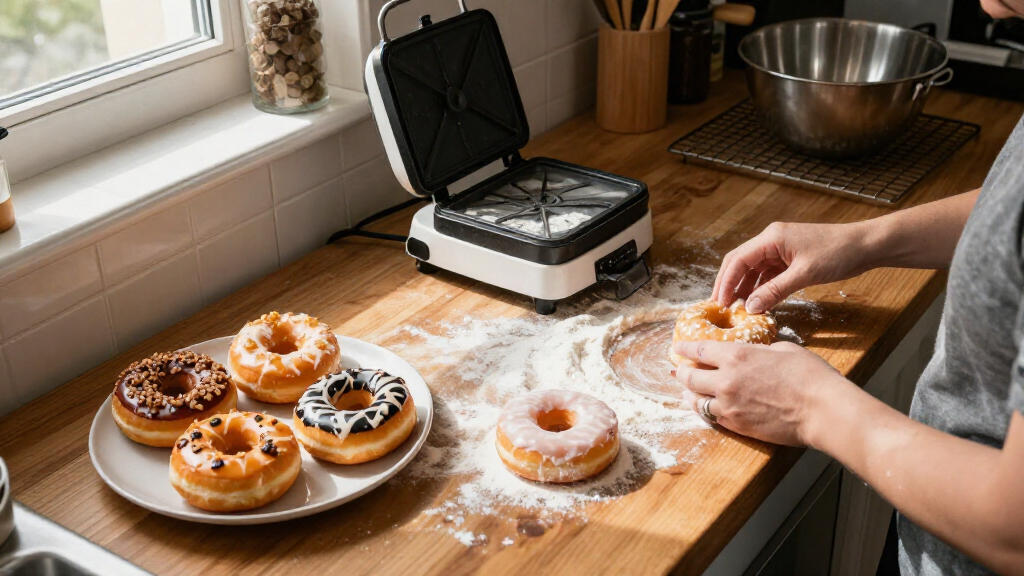
I ranked these specialty donut makers by the factors that change the buying experience: batch capacity, operating format, cleanup, and included tools. I gave higher placement to options with a clear advantage for a defined buyer, such as the FOHERE’s four-row design for larger batches or the JOVELL’s 16 cavities and included accessories. For countertop models, cavity count matters, but it does not automatically make a machine the better choice if a buyer only needs occasional small batches.
I also considered coating type, handling features, and format differences. Compact electric makers can reduce the effort of portioning and shaping, while a manual maker or pan may suit someone who prefers more control or already has suitable bakeware. Closely related products remain separate because their stated cavity counts, colors, and accessory bundles differ. The order reflects how clearly each option serves its likely use, not a claim that every buyer needs the largest machine.
Factors to Consider When Choosing Specialty Donut Makers
Before choosing among specialty donut makers, decide how you will actually make and serve donuts. Batch size, available storage, and preferred workflow often matter more than a long feature list; the right fit is the one you will use without crowding your kitchen or creating extra cleanup.
Match Cavity Count to Your Usual Batch
A larger cavity count can shorten the number of rounds needed when you are serving a group, but it may be excessive for a household that wants a few fresh donuts at a time. Think about the number of people you typically bake for and whether you would rather make several small rounds or one larger batch. Also check whether the maker’s cavities produce mini donuts or a size closer to a standard treat; cavity count alone does not tell you serving size. A high-capacity unit can save repeat loading, yet it may take more room to store and handle. For occasional use, a six- or seven-cavity option may be easier to justify than a commercial-style format. Choose capacity around your regular routine, not a rare party scenario.
Choose the Format Before Comparing Extras
Electric countertop makers, manual donut makers, and pans support different ways of working. An electric appliance is geared toward shaping and cooking donuts in a dedicated device, while a manual tool typically leaves more of the preparation and cooking process to you. A pan can suit bakers who prefer using an oven and already have space for bakeware. Do not treat these formats as direct substitutes just because each can produce donuts. Consider how much control you want over batter, shaping, and the cooking process, as well as which appliances you already use. Picking the format first narrows the field more effectively than comparing accessory bundles across unlike products.
Read Coating Claims as a Cleanup Tradeoff
Non-stick and ceramic-coated surfaces are intended to help with release and make cleanup less of a chore, but coatings still call for careful handling. Use utensils and cleaning methods suited to the manufacturer’s directions rather than assuming a coated surface can withstand rough scraping. A coating may reduce sticking, but it cannot compensate for overfilling cavities or using a batter that does not suit the appliance. Buyers who bake often may care more about maintenance guidance and replacement options than someone who uses a maker occasionally. Check whether the maker’s instructions clarify cleaning, seasoning, and utensil use before you buy. Treat coating as one part of the maintenance picture, not a promise of effortless cleanup.
Check Storage and Handling in Your Kitchen
Countertop appliances need room not only for storage but also for safe use while hot. Before buying, measure the cabinet or shelf where the maker will live and the counter area where you plan to operate it. Cool-touch details and included gloves can help with handling, but they do not remove the need to follow safe operating instructions. A large, high-capacity design may be a better fit for a dedicated baking space than a kitchen where appliances must be packed away after every use. Look at the cord, hinge, lid, and storage position if those details are listed by the manufacturer. A small footprint can matter more than extra cavities when counter space is limited.
Decide Whether Accessories Solve a Real Problem
An oil brush, gloves, or other bundled tools may make setup more convenient, especially for someone who does not already own basic baking accessories. Still, a bundle should not outweigh a mismatch in capacity, format, or storage needs. Check what is actually included and whether each item supports a task you expect to do; accessory lists can vary even among products with similar names. If you already have suitable brushes and heat-safe gloves, an accessory kit may add little value for your kitchen. If you are building a small baking setup from scratch, included tools can reduce the number of separate items to source. Compare the appliance itself first, then decide whether the extras meaningfully improve your routine.
Look Beyond the First Batch
Specialty donut makers can encourage frequent use, so think about the full routine: preparing batter, filling cavities, waiting between batches, and cleaning up. A machine that makes more donuts per round can help with serving a crowd, but it may not save time if filling and cleaning the larger surface becomes awkward. Smaller batches can be easier to manage when you want to test a recipe or make more than one flavor. Consider whether you will decorate the donuts after cooking and whether your counter has room for cooling and finishing them. Buyers often focus on cooking capacity and forget the space needed for the rest of the process. A workable kitchen flow can matter as much as the maker’s stated number of cavities.
Frequently Asked Questions
Is a 16-cavity or four-row donut maker too large for occasional home use?
It can be more capacity than a small household needs, especially if the maker will be stored away between uses. A larger batch format makes more sense when you regularly serve several people or want fewer rounds of cooking. For occasional treats, a compact six- or seven-cavity option may be easier to store and manage. Check the appliance’s dimensions and the amount of counter space it needs while open, not just its cavity count. If you are unsure, choose based on your typical baking day rather than the biggest gathering you might host.
Should I choose a countertop donut maker, a manual maker, or a pan?
Choose by the process you want, rather than assuming one format makes better donuts for every kitchen. A countertop appliance offers a dedicated cooking setup, while a manual maker generally leaves more shaping and cooking decisions to you. A pan suits people who prefer oven baking or already use bakeware for small treats. Think about whether you want a repeatable appliance routine or more control over preparation. Storage, cleanup, and the equipment you already own can make the decision clearer than the product label alone.
Do included accessories make a donut maker a better buy?
Accessories help when they cover a task you do not already have tools for, such as brushing a surface or handling a hot appliance. They are less persuasive if they duplicate equipment in your kitchen or do not match how you plan to bake. Compare the maker’s capacity, format, and care needs before assigning much weight to a bundle. Also check the product listing for the exact items included, since similarly named models may have different packages. A useful accessory can simplify setup, but it cannot fix a poor fit for your kitchen.
Is a non-stick or ceramic-coated surface easier to maintain?
Either coating may help with donut release, but proper care still matters. Follow the maker’s cleaning instructions and avoid tools or cleaners that could damage the surface. Batter quantity and consistency also affect sticking, so a coated plate is not a substitute for following the recipe and filling guidance. If you bake often, look for clear care instructions and consider how easy the cooking surface is to access for cleaning. The coating is one useful feature, not a guarantee that every batch will release or clean up without effort.
What should I prioritize if I have limited counter and storage space?
Start with the maker’s stored dimensions and the space it needs during use, including room to open the lid or handle hot parts. A lower cavity count may be a better fit if it means the appliance is easier to store and take out regularly. Consider whether a pan or manual option fits your existing kitchen tools better than another countertop appliance. Do not choose a larger model solely for its batch count if you will struggle to store or operate it. A compact design that suits your routine is more useful than extra capacity that stays in the cupboard.
Conclusion
For the broadest use across larger batches, I would start with the FOHERE Commercial Automatic 4-Row Mini Donut Maker as the best overall pick, provided its higher-capacity format suits your space. The JOVELL 16-Hole Mini Donut Maker is the best choice for buyers who want a generous cavity count plus bundled tools, while the Dash Mini Donut Maker is a straightforward middle-ground option for beginners who prefer a seven-donut batch. For value, compare the compact six- and seven-cavity models by the features you will use rather than choosing on brand name alone. The AshGlen ceramic-coated pan suits buyers who prefer an oven-based route, and the Norpro Donut Maker is the specific pick for shoppers seeking a manual format. In short, choose by your usual batch size and kitchen setup first; let accessories and coating break ties after that.
Halloween Picks
halloween
As an affiliate, we earn on qualifying purchases.