For checking a baking stone, I’d choose the TEMIRUP IR07 as the best overall option in this lineup for its infrared reading and K-type probe versatility. The Klein Tools IR1 is a simpler choice for cooks who want straightforward surface checks, while the VEVOR dual-laser thermometer stands out for a wider temperature range and more deliberate aiming. The main tradeoffs are aiming precision, useful temperature range, and whether a probe adds value for tasks beyond stone checks. A laser helps show where you’re pointing, but it does not measure temperature or make a reading more accurate by itself. Read on for the full comparison and guidance on choosing a thermometer that fits your oven and baking habits.

Get kitchen gear delivered free with Prime
- Fast, free delivery on millions of items
- Prime Video, Amazon Music and more included
- Member-only deals all year
Complete the kit


Key Takeaways
- The TEMIRUP IR07 leads for versatility: its infrared function checks the stone surface, while its K-type probe can serve other cooking or temperature-measuring tasks.
- The Klein Tools IR1 favors simplicity: it is a more focused pick for buyers who want a straightforward infrared thermometer rather than a combined surface-and-probe tool.
- Dual lasers help with aiming, not accuracy by themselves: models such as the VEVOR and TempPro TempScan PLUS TP450 offer a clearer visual cue, but the measured spot still grows with distance.
- Probe-equipped models share a clear tradeoff: options from TEMIRUP, ERICKHILL, Blackstone, and TempPro offer broader use, but the probe does not measure baking-stone surface temperature.
- Temperature range should match the oven, not just look impressive: the VEVOR’s broad stated range suits varied high-heat tasks, while buyers focused on ordinary home baking may value easier handling over extreme range.
| TEMIRUP IR05A Infrared Thermometer with Thermocouple Probe |  | Best for Long-Range Scanning | Infrared temperature range: -40°F to 2912°F | K-type probe range: 14°F to 932°F | Distance-to-spot ratio: 50:1 | VIEW ON AMAZON | See Our Full Breakdown |
| Blackstone Infrared Thermometer with Probe |  | Best for Grill-and-Pizza Cooking | Infrared temperature range: 0°F to 932°F | Probe temperature range: 122°F to 572°F | Display: Digital LCD | VIEW ON AMAZON | See Our Full Breakdown |
| ERICKHILL 2-in-1 Infrared Thermometer Gun with Meat Probe |  | Best for Everyday Cooking Versatility | Temperature range: 0°F to 1022°F | Probe accuracy: ±1°F | Probe response time: 0.5 seconds | VIEW ON AMAZON | See Our Full Breakdown |
| Klein Tools IR1 Infrared Thermometer with Targeting Laser | 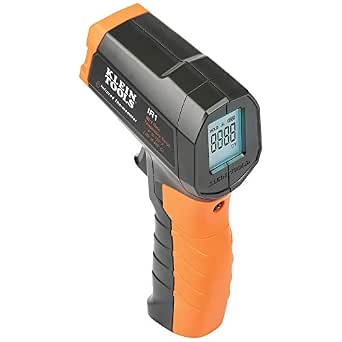 | Best Simple Stone-Temperature Pick | Measurement range: -4°F to 752°F | Distance-to-spot ratio: 10:1 | Emissivity: 0.95, fixed | VIEW ON AMAZON | See Our Full Breakdown |
| TEMIRUP IR07 Infrared Thermometer with K-Type Probe | 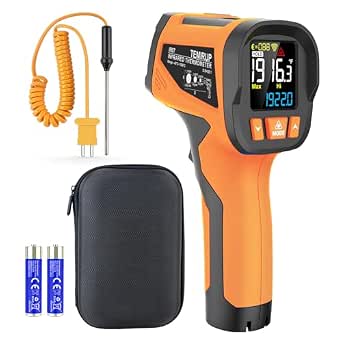 | Best Balanced Dual-Measurement Pick | Infrared temperature range: -40°F to 1922°F | K-type probe range: 14°F to 932°F | Distance-to-spot ratio: 30:1 | VIEW ON AMAZON | See Our Full Breakdown |
| Soonkoda GM50 Infrared Thermometer for Cooking |  | Best Simple, Budget-Conscious Pick | Temperature range: -58°F to 932°F (-50°C to 500°C) | Display: Backlit LCD | Resolution: 0.1°F or 0.1°C | VIEW ON AMAZON | See Our Full Breakdown |
| Etekcity Lasergrip 1080 Infrared Thermometer |  | Best for Adjustable Emissivity | Temperature range: -58°F to 1130°F (-50°C to 610°C) | Distance-to-spot ratio: 12:1 | Emissivity: Adjustable from 0.1 to 1.0 | VIEW ON AMAZON | See Our Full Breakdown |
| Etekcity Lasergrip 774 Infrared Thermometer | 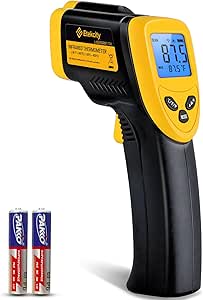 | Best for Quick, Clear Readings | Temperature range: -58°F to 842°F (-50°C to 450°C) | Distance-to-spot ratio: 12:1 | Recommended distance: About 14.17 inches (36 cm) | VIEW ON AMAZON | See Our Full Breakdown |
| Infrared Thermometer Gun with Color Display and K-Type Probe |  | Best for High-Temperature Range | Temperature range: -58°F to 1472°F (-50°C to 800°C) | Measurement methods: Non-contact infrared and K-type probe | Distance-to-spot ratio: 12:1 | VIEW ON AMAZON | See Our Full Breakdown |
| TempPro TempScan 2-in-1 Infrared Thermometer with Meat Probe |  | Best for Stone-and-Food Temperature Checks | Model: TempScan PLUS TP420 | Measurement types: Infrared surface and probe | Infrared upper temperature range: 1022°F | VIEW ON AMAZON | See Our Full Breakdown |
| TempPro TempScan Infrared Thermometer Gun |  | Best for Tracking Hot and Cool Areas | Temperature range: -58°F to 1022°F | Accuracy: ±1.5% | Adjustable emissivity: 0.1–1.0 | VIEW ON AMAZON | See Our Full Breakdown |
| VEVOR Dual-Laser Infrared Thermometer, -40°F to 2732°F |  | Best for High-Heat Versatility | Temperature range: -40°F to 2732°F (-40°C to 1500°C) | Emissivity: Adjustable from 0.10 to 1.00 | Distance-to-spot ratio: 50:1 | VIEW ON AMAZON | See Our Full Breakdown |
| KNINE OUTDOORS Infrared Thermometer Gun, -58°F to 1112°F |  | Best for Straightforward Stone Checks | Temperature range: -58°F to 1112°F (-50°C to 600°C) | Distance-to-spot ratio: 12:1 | Targeting: Single laser | VIEW ON AMAZON | See Our Full Breakdown |
| TempPro TempScan PLUS TP450 Infrared Thermometer with Dual Lasers |  | Best for Precise Aiming | Temperature range: -58°F to 1022°F | Accuracy: ±1.5% | Distance-to-spot ratio: 16:1 | VIEW ON AMAZON | See Our Full Breakdown |
| Goldeep Infrared Thermometer Gun with Adjustable Emissivity |  | Best Compact Pick | Temperature range: -58°F to 1022°F (-50°C to 550°C) | Emissivity: Adjustable from 0.1 to 0.99; default 0.95 | Distance-to-spot ratio: 12:1 | VIEW ON AMAZON | See Our Full Breakdown |
| infrared thermometers for baking stone temp | Distance-to-spot ratio | Response time | Emissivity | Display |
|---|---|---|---|---|
| TEMIRUP IR05A Infrared Thermom | 50:1 | 0.5 seconds | Adjustable from 0.10 to 1.00 | — |
| Blackstone Infrared Thermomete | — | — | — | Digital LCD |
| ERICKHILL 2-in-1 Infrared Ther | 12:1 | — | — | Backlit |
| Klein Tools IR1 Infrared Therm | 10:1 | 0.5 seconds | 0.95, fixed | Digital, backlit |
| TEMIRUP IR07 Infrared Thermome | 30:1 | 0.5 seconds | Adjustable from 0.10 to 1.00 | — |
| Soonkoda GM50 Infrared Thermom | — | 10,000 milliseconds | 0.95 preset | Backlit LCD |
| Etekcity Lasergrip 1080 Infrar | 12:1 | 0.5 seconds | Adjustable from 0.1 to 1.0 | Backlit digital LCD |
| Etekcity Lasergrip 774 Infrare | 12:1 | 0.5 seconds | Adjustable from 0.1 to 1.0 | Backlit LCD |
| Infrared Thermometer Gun with | 12:1 | Less than 0.5 seconds | Adjustable from 0.1 to 1.0 | Backlit color VA display |
| TempPro TempScan 2-in-1 Infrar | — | — | — | — |
| TempPro TempScan Infrared Ther | 12:1 | Under 0.5 seconds | — | — |
| VEVOR Dual-Laser Infrared Ther | 50:1 | 0.25 seconds | Adjustable from 0.10 to 1.00 | Backlit color digital display |
| KNINE OUTDOORS Infrared Thermo | 12:1 | — | — | Digital LCD |
| TempPro TempScan PLUS TP450 In | 16:1 | 0.5 seconds | Adjustable from 0.1 to 1.0 | — |
| Goldeep Infrared Thermometer G | 12:1 | 0.8 seconds | Adjustable from 0.1 to 0.99; default 0.95 | Backlit digital LCD |
More Details on Our Top Picks
TEMIRUP IR05A Infrared Thermometer with Thermocouple Probe
The IR05A’s 50:1 distance-to-spot ratio makes it the strongest fit here for checking a hot baking stone from farther back: the measurement spot stays more contained at a distance than on the Klein Tools IR1, which has a 10:1 ratio. Adjustable emissivity also gives you a way to account for surface differences, though the stone’s finish can still affect infrared readings. Its 0.5-second response and MIN, MAX, AVG, and DIF modes help compare areas across the stone without lingering over the oven opening.
The included K-type probe adds contact readings for compatible tasks, but its 932°F ceiling is far below the IR05A’s 2912°F infrared ceiling. The tradeoff is a more involved tool than a baking-only buyer may need, and the stated ±2% average IR accuracy leaves room for measurement variation. I’d choose it over the simpler Klein when distance and adjustable emissivity matter more than straightforward operation.
Pros:- 50:1 distance-to-spot ratio supports more contained readings from farther away than the Klein Tools IR1
- Infrared range reaches 2912°F, well above the temperatures typically needed for baking stones
- Adjustable emissivity offers more flexibility across different surface finishes
- Includes a K-type probe, alarms, and MIN, MAX, AVG, and DIF modes
Cons:- Infrared accuracy is listed as ±2% average, so readings are not exact reference measurements
- The included probe tops out at 932°F, much lower than the infrared range
- The additional modes and accessories may be unnecessary for basic stone checks
Best for: Bakers who want to scan a large or very hot stone from farther away and value adjustable emissivity and multiple reading modes.
Not ideal for: Casual home bakers who only need a quick stone check and would rather avoid extra modes, probe accessories, and setup choices.
- Infrared temperature range:-40°F to 2912°F
- K-type probe range:14°F to 932°F
- Distance-to-spot ratio:50:1
- Infrared accuracy:±2% average
- Emissivity:Adjustable from 0.10 to 1.00
- Response time:0.5 seconds
- Measurement modes:MIN, MAX, AVG, DIF
- Display and power:Backlit color screen; 2 AA batteries included
Our verdict“Choose the IR05A if you want long-range stone scanning and adjustable measurement settings more than a simple, baking-only tool.”
Blackstone Infrared Thermometer with Probe
The Blackstone 5400 pairs a surface-reading infrared gauge with a folding probe for internal food temperatures, making it a practical choice for cooks who move between checking a stone and checking food. Its infrared range reaches 932°F, enough for many home baking and grilling tasks, while the LCD’s 0.1-degree resolution gives readings in fine increments. Compared with the Klein Tools IR1, which measures surfaces only, the Blackstone adds a food probe; compared with the ERICKHILL 2-in-1, it offers a shorter stated infrared range and lacks listed MAX/MIN/AVG functions.
The compact 3.15-inch body and folding probe suit drawer storage, but the listed eight AA batteries are a substantial power requirement for a small tool. No distance-to-spot ratio or emissivity adjustment is provided in the supplied specs, so I’d favor it for general cooking versatility rather than precise stone mapping or repeatable readings across varied surfaces.
Pros:- Combines non-contact surface readings with a folding internal-food probe
- Infrared range extends to 932°F for many home cooking applications
- Compact 3.15-inch length and folding probe store easily
- LCD provides 0.1-degree resolution
Cons:- Requires eight AA batteries, more than the two-AA TEMIRUP models
- No distance-to-spot ratio or emissivity adjustment is listed
- Probe range is limited to 572°F
Best for: Pizza and grill cooks who want one compact tool for checking stone surfaces and probing food.
Not ideal for: Bakers who need a stated distance-to-spot ratio, adjustable emissivity, or detailed temperature tracking for comparing different areas of a stone.
- Infrared temperature range:0°F to 932°F
- Probe temperature range:122°F to 572°F
- Display:Digital LCD
- Resolution:0.1°F or 0.1°C
- Power:8 AA batteries
- Length:3.15 inches
- Weight:4 ounces
- Probe design:Folding
Our verdict“Pick the Blackstone if you want a compact surface-and-food thermometer for mixed cooking tasks and can accept its battery demand.”
ERICKHILL 2-in-1 Infrared Thermometer Gun with Meat Probe
For cooks who want stone readings and food checks in one device, the ERICKHILL 2-in-1 offers a useful balance: its infrared range reaches 1022°F, and its folding stainless-steel probe is specified with ±1°F accuracy and a 0.5-second response. The backlit display and MAX, MIN, and AVG functions can help when checking whether the stone has warmed evenly. Compared with the Blackstone 5400, it has a higher stated infrared ceiling and more reading functions; compared with the TEMIRUP IR07, it does not list adjustable emissivity or temperature alarms.
The 12:1 distance-to-spot ratio is less suited to scanning from farther back than the TEMIRUP models’ 30:1 and 50:1 ratios, so I’d keep the gun close enough that its target covers only the area you mean to read. Battery requirements are not specified, which makes replacement planning less clear. This is a flexible cooking pick, not the most specialized option for distant stone measurements.
Pros:- Infrared range reaches 1022°F, above the Blackstone 5400’s stated 932°F ceiling
- Food-grade stainless-steel probe folds through 180 degrees for storage
- Probe accuracy is specified as ±1°F with a 0.5-second response
- Backlit display, data hold, and MAX/MIN/AVG readings support cooking checks
Cons:- 12:1 distance-to-spot ratio is less suited to distant stone scanning than the TEMIRUP IR07 or IR05A
- Adjustable emissivity is not listed
- Battery requirements are not specified
Best for: Home cooks who want a single device for checking baking surfaces and probing meat, with a backlit screen and basic temperature tracking.
Not ideal for: Bakers who need long-range targeting or adjustable emissivity to compare readings across stones with different surface finishes.
- Temperature range:0°F to 1022°F
- Probe accuracy:±1°F
- Probe response time:0.5 seconds
- Distance-to-spot ratio:12:1
- Probe material:Food-grade stainless steel
- Probe design:180° foldable
- Display:Backlit
- Additional functions:MAX/MIN/AVG readings, data hold, auto shut-off
Our verdict“Choose the ERICKHILL for cooking versatility and a capable folding probe, but choose a TEMIRUP model for longer-range stone scanning.”
Klein Tools IR1 Infrared Thermometer with Targeting Laser
The Klein Tools IR1 is the least complicated surface-only choice in this group: point the laser, read the backlit display, and use auto-hold to keep the measurement visible. Its -4°F to 752°F range covers many home baking-stone checks, though it leaves less headroom than the Blackstone 5400’s 932°F ceiling and the ERICKHILL’s 1022°F range. That narrower range is unlikely to trouble most home bakers, but it makes the Klein a less flexible pick for unusually hot cooking setups.
Its 10:1 distance-to-spot ratio means I’d use it closer to the stone than the TEMIRUP IR07, whose 30:1 ratio supports scanning from farther back. The Klein’s fixed 0.95 emissivity keeps operation simple but offers no adjustment for different finishes. It also has no food probe, so cooks who want internal readings should choose the Blackstone or ERICKHILL instead.
Pros:- Simple non-contact operation with laser targeting and auto-hold
- Backlit display is useful around a dim oven or kitchen
- 0.5-second response supports quick surface checks
- Compact 6.01-inch length and included pouch aid storage
Cons:- 10:1 distance-to-spot ratio requires closer targeting than the TEMIRUP IR07
- Fixed emissivity of 0.95 cannot be adjusted for different surfaces
- 752°F upper limit is lower than the Blackstone 5400 and ERICKHILL
Best for: Home bakers who want a straightforward, surface-only thermometer for routine stone checks and do not need a food probe.
Not ideal for: Bakers who need readings from farther away, adjustable emissivity, or a range extending above 752°F.
- Measurement range:-4°F to 752°F
- Distance-to-spot ratio:10:1
- Emissivity:0.95, fixed
- Response time:0.5 seconds
- Targeting:Laser
- Display:Digital, backlit
- Power:2 AA batteries included
- Length and weight:6.01 inches; 100 g
Our verdict“Pick the Klein IR1 for simple routine stone checks, but choose a higher-range or adjustable-emissivity model for more demanding measurements.”
TEMIRUP IR07 Infrared Thermometer with K-Type Probe
The TEMIRUP IR07 balances useful baking-stone features with a less extreme range than the IR05A: its 30:1 distance-to-spot ratio is well suited to scanning a stone from back from the oven, while adjustable emissivity lets buyers account for surface differences. MIN, MAX, and average tracking, plus high/low alarms, can help flag uneven heating or a target temperature. Compared with the Klein Tools IR1, the IR07 has a longer reach, a broader infrared range, and emissivity adjustment; compared with the TEMIRUP IR05A, its maximum infrared temperature is lower at 1922°F.
For ordinary baking stones, that lower ceiling is unlikely to limit use, and the included K-type probe adds a contact option for suitable measurements. However, the probe tops out at 932°F, and the stated IR accuracy is ±2%. This is a more practical fit than the IR05A for buyers who want a dual-measurement tool without paying attention to extreme high-temperature capacity.
Pros:- 30:1 distance-to-spot ratio supports stone scanning from farther away than the Klein IR1
- Adjustable emissivity from 0.10 to 1.00 offers flexibility across surface finishes
- Includes a K-type probe, MIN/MAX/average tracking, and high/low alarms
- Two AA batteries, storage bag, and screwdriver are included
Cons:- Infrared accuracy is listed as ±2%
- Probe range tops out at 932°F, below the infrared range
- Its extra probe and tracking features may be unnecessary for occasional stone checks
Best for: Frequent pizza and bread bakers who want adjustable infrared readings, longer-range stone scanning, and a probe for other cooking checks.
Not ideal for: Buyers who need the highest listed infrared ceiling in this group or who only want a basic surface thermometer without extra functions.
- Infrared temperature range:-40°F to 1922°F
- K-type probe range:14°F to 932°F
- Distance-to-spot ratio:30:1
- Infrared accuracy:±2%
- Probe accuracy:±1.5%
- Emissivity:Adjustable from 0.10 to 1.00
- Response time:0.5 seconds
- Power and display:2 AA batteries included; backlit color LCD
Our verdict“Choose the IR07 for a balanced mix of longer-range stone scanning, adjustable emissivity, and probe versatility without needing the IR05A’s higher ceiling.”
Soonkoda GM50 Infrared Thermometer for Cooking
For checking whether a baking stone has reached baking temperature, the GM50 covers the basic job without extra probe functions or setup: point it at the stone and read the surface temperature on its backlit LCD. Its range reaches 932°F, comfortably covering typical home pizza-baking temperatures. Compared with the Etekcity Lasergrip 1080, it offers fewer controls and a narrower upper range, but that may suit buyers who only need occasional stone checks. The main caution is its listed 10-second response time, which is much slower than the quick-reading alternatives here; that can make repeated checks less convenient. Its fixed 0.95 emissivity can also misread shiny metal, though a matte baking stone is a more suitable target. I’d choose it for simple stone-temperature checks, not fast, frequent scanning.
Pros:- Non-contact readings keep hands away from a hot baking stone
- 932°F upper range covers common high-heat baking needs
- Backlit display and data hold help with reading and recording temperatures
- Two AAA batteries are included
Cons:- Listed 10-second response time is slow beside the 0.5-second alternatives
- Fixed 0.95 emissivity may produce inaccurate readings on shiny or polished surfaces
- Not intended for measuring human body temperature
Best for: Home bakers who want a straightforward non-contact thermometer for occasional checks of a matte pizza stone.
Not ideal for: Bakers who scan several spots rapidly or need dependable measurements from shiny metal surfaces.
- Temperature range:-58°F to 932°F (-50°C to 500°C)
- Display:Backlit LCD
- Resolution:0.1°F or 0.1°C
- Emissivity:0.95 preset
- Response time:10,000 milliseconds
- Power:2 AAA batteries, included
- Automatic shutoff:About 8 seconds
- Length:5.83 inches
Our verdict“Choose the GM50 for uncomplicated, occasional checks of a matte baking stone, but skip it if you want rapid scanning or adjustable emissivity.”
Etekcity Lasergrip 1080 Infrared Thermometer
The Lasergrip 1080 is a strong fit for bakers who want more control over how a thermometer reads different surfaces. Its adjustable emissivity spans 0.1–1.0, unlike the fixed setting on the Soonkoda GM50, so it can be tuned when you check surfaces beyond a typical matte stone. For routine baking, the 0.5-second response and 12:1 distance-to-spot ratio make it practical to scan several areas without lingering over the oven. Its 1130°F ceiling also gives more headroom than the Etekcity Lasergrip 774. The tradeoff is that emissivity and aiming still require care: readings represent a target area, and holding the thermometer too far away can include surrounding surfaces. I’d favor this model when flexibility matters more than a simple, fixed-setting workflow.
Pros:- Adjustable emissivity from 0.1 to 1.0 offers flexibility across surface types
- 0.5-second response supports quick spot checks
- 1130°F upper range provides more headroom than the Lasergrip 774
- 12:1 distance-to-spot ratio and backlit display aid practical scanning
Cons:- Readings depend on keeping distance and target size appropriate
- Not intended for human temperature measurement
Best for: Bakers who check both matte baking stones and other household surfaces and want to adjust emissivity for different targets.
Not ideal for: Buyers who want a no-adjustment thermometer or who cannot keep the target area properly sized and centered.
- Temperature range:-58°F to 1130°F (-50°C to 610°C)
- Distance-to-spot ratio:12:1
- Emissivity:Adjustable from 0.1 to 1.0
- Response time:0.5 seconds
- Repeatability:1% / 1°C
- Display:Backlit digital LCD
- Units:°F and °C
- Power:2 AAA batteries, included
Our verdict“Pick the Lasergrip 1080 if you want a fast stone thermometer with adjustable emissivity and broader surface-measuring flexibility.”
Etekcity Lasergrip 774 Infrared Thermometer
For baking-stone checks, the Lasergrip 774 keeps the process quick: it returns a reading in about 0.5 seconds and shows it on a backlit LCD. Like the more adjustable Lasergrip 1080, it offers emissivity control and a 12:1 distance-to-spot ratio, but its 842°F ceiling is lower. That remains enough for many stone-baking routines, yet gives less headroom if you work at especially high temperatures or want one tool for hotter surfaces. Its maximum-temperature display can help spot the hottest area during a scan, while the reading still averages the temperature across the targeted area rather than measuring a pinpoint. I’d choose the 774 for fast home-kitchen checks, not for buyers who need the wider range of the 1080.
Pros:- Fast, approximately 0.5-second readings make repeated stone checks convenient
- Adjustable emissivity from 0.1 to 1.0
- Maximum-temperature display can help identify hotter areas
- Backlit LCD and included AAA batteries support ready-to-use operation
Cons:- 842°F upper limit is lower than the Lasergrip 1080’s 1130°F range
- Measures the average temperature across the targeted surface area
- Not intended for human temperature measurement
Best for: Home pizza bakers who want fast readings, adjustable emissivity, and a maximum-temperature display for scanning a stone.
Not ideal for: Bakers working above 842°F or those who need readings from a very small, precisely isolated spot.
- Temperature range:-58°F to 842°F (-50°C to 450°C)
- Distance-to-spot ratio:12:1
- Recommended distance:About 14.17 inches (36 cm)
- Emissivity:Adjustable from 0.1 to 1.0
- Response time:0.5 seconds
- Repeatability:1% / 1°C
- Measurement increments:±2%
- Display:Backlit LCD
Our verdict“Choose the Lasergrip 774 for quick, feature-rich checks within its 842°F range; choose the Lasergrip 1080 for more temperature headroom.”
Infrared Thermometer Gun with Color Display and K-Type Probe
This thermometer’s 1472°F upper limit gives it the most headroom among the five options here, making it a better fit for very hot ovens and for buyers who also measure other high-temperature surfaces. For a baking stone, its sub-0.5-second infrared response and adjustable emissivity offer the essentials for fast surface checks. The included K-type probe adds a second way to measure, unlike the infrared-only Lasergrip 1080 and 774, though a probe is not a substitute for scanning the stone’s surface. The extra functions bring a more involved tool: ambient temperature and humidity readings, alarms, and accessories may be unnecessary if your only task is checking stone heat. Battery life is listed as eight hours, so I’d select it for range and measurement flexibility rather than simplicity.
Pros:- 1472°F upper limit offers more headroom than the other listed options
- Infrared and K-type probe measurement provide two measurement methods
- Adjustable emissivity and sub-0.5-second response suit fast surface scanning
- Color backlit display, alarms, and included carry accessories add versatility
Cons:- Eight-hour listed battery life may be limiting for frequent or extended use
- Extra probe, humidity, ambient, and alarm functions may be unnecessary for stone-only checks
- Readings are intended for inanimate objects, not people or animals
Best for: Bakers with very high-temperature ovens who also want a probe and temperature alarms for other cooking or workshop tasks.
Not ideal for: Buyers who only need occasional stone readings and prefer a simpler tool with fewer functions to manage.
- Temperature range:-58°F to 1472°F (-50°C to 800°C)
- Measurement methods:Non-contact infrared and K-type probe
- Distance-to-spot ratio:12:1
- Emissivity:Adjustable from 0.1 to 1.0
- Accuracy:±1.5%
- Response time:Less than 0.5 seconds
- Display:Backlit color VA display
- Included accessories:K-type probe, screwdriver, carry bag, batteries, and user manual
Our verdict“Choose this model if your stone runs especially hot and you’ll use its probe and alarms elsewhere; for basic stone checks, a simpler thermometer is easier to justify.”
TempPro TempScan 2-in-1 Infrared Thermometer with Meat Probe
The TempScan suits cooks who want to check a stone’s surface and then measure food internally with the same tool. Its 0.5-second infrared mode is suited to scanning a hot stone, while the fold-out probe reads food or liquids in 2–3 seconds. Compared with the probe-equipped Infrared Thermometer Gun with Color Display and K-Type Probe, the TempScan’s listed upper range is lower at 1022°F, but its stated probe accuracy of ±1.8°F and motion-sensing sleep and wake make it a focused kitchen option. The 12:1 distance-to-spot ratio calls for sensible aiming so the stone fills the target area. Its main compromise is that buyers paying attention only to stone temperature carry a probe they may rarely use. I’d pick it for cooks who want both surface and internal readings.
Pros:- Combines infrared stone scanning with a probe for internal food and liquid temperatures
- Infrared readings take about 0.5 seconds
- Probe response is listed at 2–3 seconds with ±1.8°F accuracy
- Motion-sensing sleep and wake help reduce unnecessary power use
Cons:- 1022°F upper range is below the color-display K-type model’s 1472°F ceiling
- Probe accuracy is specified as ±1.8°F
- Requires two AAA batteries
Best for: Pizza bakers who also want to check the internal temperature of meat or liquids without keeping a separate probe thermometer.
Not ideal for: Stone-only users who want the highest available temperature range or have no use for an internal food probe.
- Model:TempScan PLUS TP420
- Measurement types:Infrared surface and probe
- Infrared upper temperature range:1022°F
- Infrared distance-to-spot ratio:12:1
- Infrared response time:0.5 seconds
- Probe accuracy:±1.8°F
- Probe response time:2–3 seconds
- Power:2 AAA batteries, included
Our verdict“Choose the TempScan if you want one kitchen tool for both baking-stone surfaces and internal food temperatures.”
TempPro TempScan Infrared Thermometer Gun
The TempPro TempScan suits bakers who want more than a single spot check: its display reports maximum, minimum, and average readings, helping you compare hotter and cooler parts of a stone as it heats. Its adjustable emissivity offers flexibility across surfaces, while the 12:1 distance-to-spot ratio is a practical fit for checking a home oven without reaching toward the stone. Compared with the TempPro TempScan PLUS TP450, it gives up dual-laser targeting and a longer 16:1 ratio, so aiming at a small area takes more care. The 0.5-second response is quick enough for routine checks, but its 1022°F ceiling and surface-only readings limit its role to temperature mapping—not checking food’s internal temperature. I’d choose it for useful readout functions over more precise targeting.
Pros:- Maximum, minimum, and average readings help reveal temperature variation across the stone.
- Adjustable emissivity from 0.1 to 1.0 accommodates different surface materials.
- Backlit display is easier to read in a dim kitchen.
- 0.5-second response supports quick checks between baking sessions.
Cons:- The 12:1 distance-to-spot ratio is less suited to targeting a small area from farther away than the TP450’s 16:1 ratio.
- Measures surface temperature only, not the internal temperature of food.
- Requires two AAA batteries.
Best for: Home pizza bakers who want to compare hot spots and cooler zones across a baking stone.
Not ideal for: Bakers who need dual-laser aiming, a longer distance-to-spot ratio, or readings above 1022°F.
- Temperature range:-58°F to 1022°F
- Accuracy:±1.5%
- Adjustable emissivity:0.1–1.0
- Distance-to-spot ratio:12:1
- Response time:Under 0.5 seconds
- Display and readings:Backlit LCD; maximum, minimum, and average
- Power:2 AAA batteries
- Weight:128 g
Our verdict“Choose the TempScan if tracking temperature variation across your stone matters more than dual-laser targeting.”
VEVOR Dual-Laser Infrared Thermometer, -40°F to 2732°F
The VEVOR IR05 has the broadest temperature range in this group, reaching 2732°F, far beyond what most baking-stone checks require. That headroom makes it a better fit for buyers who also monitor kilns, machinery, or other very hot surfaces. For ordinary oven use, its 50:1 distance-to-spot ratio and dual lasers can help target an area from farther back, though a laser marks aiming rather than the exact boundaries of the measured spot. Compared with the TempPro TempScan PLUS TP450, the VEVOR offers much more temperature capacity and a faster 0.25-second response, but it is heavier and built around broader industrial use. Adjustable emissivity and an alarm add flexibility, while the short 35-second auto-shutdown may interrupt longer checks. I’d skip it if stone temperature is your only task.
Pros:- Very wide range reaches 2732°F for high-heat tasks beyond baking.
- 50:1 distance-to-spot ratio supports measurement from farther away.
- Dual lasers help frame the target area while aiming.
- Adjustable emissivity, alarm settings, and a backlit color display add control.
Cons:- Its industrial temperature capacity is more than most baking-stone users need.
- At 11.36 ounces, it is heavier than the TempPro TempScan PLUS TP450.
- Auto-shutdown after 35 seconds can be inconvenient during extended checks.
Best for: Bakers who also need one infrared tool for very high-temperature equipment or industrial and automotive surface checks.
Not ideal for: Pizza-stone-only users who prefer a lighter, simpler thermometer sized for routine oven checks.
- Temperature range:-40°F to 2732°F (-40°C to 1500°C)
- Emissivity:Adjustable from 0.10 to 1.00
- Distance-to-spot ratio:50:1
- Response time:0.25 seconds
- Laser configuration:Dual laser
- Display:Backlit color digital display
- Power:2 AA batteries
- Weight:11.36 ounces
Our verdict“Pick the VEVOR if you need long-distance targeting and very high temperature capacity beyond baking-stone work.”
KNINE OUTDOORS Infrared Thermometer Gun, -58°F to 1112°F
The KNINE OUTDOORS thermometer keeps the task simple: point its single laser at the stone, select Fahrenheit or Celsius, and read the surface temperature on the LCD. Its 12:1 distance-to-spot ratio is similar to the TempPro TempScan, so both suit close-range kitchen checks better than the VEVOR IR05 when aiming from farther away. KNINE’s stated upper limit of 1112°F gives it slightly more range than the TempScan’s 1022°F, while adjustable emissivity provides useful flexibility for different surfaces. The tradeoff is a fairly basic setup: the description lists no maximum, minimum, or average readings, unlike the TempScan, and the plastic body offers little indication of extra durability. It measures surface temperature only, so it cannot replace a probe when you need food’s internal temperature.
Pros:- 1112°F upper range exceeds the TempPro TempScan’s 1022°F limit.
- Selectable Fahrenheit and Celsius units support different preferences.
- Adjustable emissivity from 0.1 to 1.0 offers surface-reading flexibility.
- 12:1 distance-to-spot ratio suits routine close-range checks.
Cons:- Single-laser targeting offers less aiming guidance than the dual-laser TempPro TempScan PLUS TP450.
- No maximum, minimum, or average reading functions are listed.
- Measures surface temperature rather than food’s internal temperature.
Best for: Home bakers who want a no-frills infrared gun for checking stone temperature in either Fahrenheit or Celsius.
Not ideal for: Users who want stored high/low/average readings, dual-laser guidance, or a tougher specified housing.
- Temperature range:-58°F to 1112°F (-50°C to 600°C)
- Distance-to-spot ratio:12:1
- Targeting:Single laser
- Display:Digital LCD
- Resolution:0.1°C or 0.1°F
- Selectable units:°C and °F
- Adjustable emissivity:0.1–1.0
- Power:2 AAA batteries
Our verdict“Choose KNINE for uncomplicated stone checks and a modestly higher temperature ceiling, not for advanced tracking features.”
TempPro TempScan PLUS TP450 Infrared Thermometer with Dual Lasers
The TempScan PLUS TP450 is the strongest fit here for bakers who want help aiming at a particular section of a stone. Its dual lasers mark the area being targeted, while a 16:1 distance-to-spot ratio gives it an advantage over the 12:1 TempPro TempScan and KNINE models when checking from farther back. The ratio does not make the measured spot as small as the laser dots may suggest, so close positioning still matters for small targets. Its -58°F to 1022°F range covers typical baking-stone checks, and MAX/MIN/AVG readings help track temperature changes. Compared with the VEVOR IR05, it lacks extreme high-heat capacity and a 50:1 ratio, but is a more focused choice for kitchen use. It still reads surfaces only.
Pros:- Dual lasers make it easier to aim at a selected section of the stone.
- 16:1 distance-to-spot ratio is longer than the 12:1 TempScan and KNINE ratios.
- MAX, MIN, and AVG readings help track temperature variation.
- Adjustable emissivity and a backlit display suit varied surfaces and dim oven areas.
Cons:- Its 1022°F maximum is far below the VEVOR IR05’s 2732°F ceiling.
- Laser marks do not eliminate the need to account for the measured spot’s size.
- Measures surface temperature only and requires two AAA batteries.
Best for: Pizza bakers who want dual-laser aiming and temperature tracking while checking different zones of a stone.
Not ideal for: Buyers who need readings above 1022°F or a 50:1 distance-to-spot ratio for work from farther away.
- Temperature range:-58°F to 1022°F
- Accuracy:±1.5%
- Distance-to-spot ratio:16:1
- Response time:0.5 seconds
- Emissivity:Adjustable from 0.1 to 1.0
- Resolution:0.1°F or 0.1°C
- Display and readings:Backlit digital; maximum, minimum, and average
- Power and weight:2 AAA batteries; 0.05 kg
Our verdict“Pick the TP450 if easier targeting and a longer working distance matter more than an industrial-level temperature range.”
Goldeep Infrared Thermometer Gun with Adjustable Emissivity
At 6.6 inches long, the Goldeep JD-16 is a compact option for bakers who want a basic infrared gun that is easy to keep with their oven tools. Its 12:1 distance-to-spot ratio and laser give a familiar close-range setup, much like the KNINE OUTDOORS thermometer, while adjustable emissivity lets you tune readings for different surfaces. A data hold function can keep a measurement visible long enough to read, though the listed 0.8-second response is slower than the TempPro TempScan’s under-0.5-second response and the VEVOR IR05’s 0.25 seconds. Its range reaches 1022°F, adequate for routine stone checks but lower than KNINE’s 1112°F and nowhere near VEVOR’s industrial ceiling. The spec sheet does not list accuracy or high/low/average tracking, so buyers seeking more measurement detail should compare the TempScan models.
Pros:- Compact 6.6-inch length is easy to store with other oven tools.
- Adjustable emissivity from 0.1 to 0.99 supports different surface materials.
- Data hold helps keep a reading visible after measurement.
- Backlit display and °C/°F switching support straightforward operation.
Cons:- 0.8-second response is slower than the TempPro TempScan and VEVOR IR05.
- No accuracy figure or maximum, minimum, and average functions are listed.
- The measured spot grows as distance increases, limiting far-away checks of small areas.
Best for: Bakers who want a compact, easy-to-store infrared thermometer for occasional close-range stone checks.
Not ideal for: Frequent users who need documented accuracy, faster response, temperature-trend readings, or a higher range than 1022°F.
- Temperature range:-58°F to 1022°F (-50°C to 550°C)
- Emissivity:Adjustable from 0.1 to 0.99; default 0.95
- Distance-to-spot ratio:12:1
- Response time:0.8 seconds
- Display:Backlit digital LCD
- Units:°C and °F
- Power:2 AAA batteries
- Length:6.6 inches
Our verdict“Choose the Goldeep for compact storage and basic stone checks, but favor the TempScan models for quicker or more detailed readings.”

How We Picked
I ranked these 15 models around the job in the title: checking the surface temperature of a baking stone. I prioritized a useful measurement range for high-heat cooking, clear aiming, straightforward controls, and features that help a cook get repeatable readings across different parts of a stone. I also weighed whether extras such as a contact probe add practical value for other kitchen tasks, while keeping clear that a probe measures a different target than the infrared sensor.
The top positions go to tools whose feature mix makes sense for recurring stone checks, not simply those with the biggest specification claims. A wider range or dual lasers can help particular users, but neither replaces sound technique: measuring at a sensible distance and scanning several points. Simpler models rank well for buyers who want fewer controls, while combination tools suit cooks who will also use a probe. I treated product names and stated features as the basis for comparison and did not assume that a feature alone guarantees measurement accuracy.
Factors to Consider When Choosing Infrared Thermometers For Baking Stone Temp
Choosing an infrared thermometer for a baking stone is less about collecting features and more about matching the tool to your oven, workflow, and other cooking tasks. These factors can help narrow the field before you decide whether a basic infrared gun or a probe-equipped model is the better fit.
Match the Temperature Range to Your Oven
Start with the highest stone temperature you actually expect to measure, then leave reasonable headroom rather than paying attention only to a headline maximum. Pizza and bread ovens can run hotter than many everyday oven settings, so a thermometer designed for general household use may not suit every stone-baking setup. A very wide range, like the VEVOR’s stated range, can be useful if you measure other high-heat equipment as well. For ordinary home baking, a more focused tool may be easier to use and just as relevant. Check the thermometer’s stated range and accuracy specifications together; a large range alone does not tell you how precise it is around your target temperature. Do not use an infrared thermometer beyond its specified limits.
Understand the Spot Size and Working Distance
An infrared thermometer reads an area, not a single point, and that area gets larger as you move the tool farther away. This matters when checking a smaller stone or trying to compare its center with its edges. Use the distance-to-spot ratio in the product specifications to estimate whether the measurement area will fit on your stone from your normal viewing position. A laser marks the aim point or target area, but it does not define a tiny measurement spot unless the specifications support that interpretation. Moving closer can reduce the measured area, but never reach over a hot stone or place the device where heat may damage it. For useful comparisons, take readings from several locations at a consistent distance.
Treat Emissivity as a Surface-Matching Setting
Emissivity describes how a surface emits infrared energy, and a mismatched setting can affect the displayed reading. Baking stones are usually matte rather than shiny, but stone materials and surface finishes vary, so avoid assuming every surface behaves identically. Adjustable emissivity, such as the feature named for the Goldeep model, can help when you know the appropriate setting for the material. It can also add a chance of setup error if you change settings without a reliable reference. For repeatable home checks, use the same tool, setting, distance, and measurement locations each time. If your thermometer offers a fixed setting, check its documentation to understand how it is intended to handle your surface.
Decide Whether a Probe Will Get Used
A contact probe can make a combination thermometer more useful for meat, liquids, or other tasks, but it does not measure the stone’s surface the way the infrared function does. Do not press a probe into a hot stone unless the product instructions specifically support that use. If stone temperature is your only goal, a simpler infrared-only model may mean fewer accessories and controls to manage. If you regularly cook different foods and want both surface and internal readings from one tool, a probe-equipped model can justify its added complexity. Check how the probe stores, connects, and cleans before choosing a combination unit. The best extra feature is one that fits a task you already do.
Prioritize Repeatable Technique Over Laser Count
More lasers can make it easier to see the target area, especially when aiming across an oven opening, but they do not make the sensor inherently more accurate. A laser is an aiming aid and should never be directed toward eyes. For a consistent stone check, hold the thermometer steady, use a repeatable distance, and scan more than one spot. Avoid reading while the surface is changing quickly if you want a meaningful comparison between locations. Make sure the display is readable in your kitchen lighting and that the controls are manageable with the oven door open. A tool that supports a steady routine can be more useful than one with extra aiming features you rarely need.
Check Handling, Storage, and Heat Safety
Infrared thermometers are made to read a surface without touching it, but they are not meant to sit in an oven or withstand direct flame. Check the manual for the permitted operating and storage conditions, particularly if you use a high-heat pizza oven. A compact body can be easier to store near baking tools, while a larger display may be easier to read at a glance. Consider whether the grip, trigger, and screen suit one-handed use while you keep a safe distance from the hot stone. For probe models, account for cleaning and safe storage of the probe tip as well. These practical details matter most when a thermometer becomes part of a regular baking routine.
Frequently Asked Questions
Can an infrared thermometer give me the exact temperature of the whole baking stone?
No. It measures the surface area within its field of view, not the entire stone or its internal temperature. Stone temperatures can vary between the center, edges, and areas that receive more direct heat, so take readings at several locations. Keep your distance consistent so the measured area stays comparable. For a more complete picture, check the stone at multiple points and repeat the scan after preheating or baking as needed.
Should I buy a model with dual lasers for checking a baking stone?
Dual lasers can make aiming more intuitive, but they do not make the temperature reading more accurate on their own. The thermometer’s distance-to-spot ratio and your working distance determine how much surface the sensor reads. If you often aim into a hot oven opening or compare smaller areas, a clearer aiming aid may be useful. If you can hold a basic model steadily at a consistent distance, one laser or another aiming method may be enough. Choose based on targeting needs rather than laser count alone.
Is a thermometer with a meat probe useful if I only want to measure a stone?
If baking-stone readings are your only task, a probe is unlikely to improve those readings because the infrared sensor does that work. A probe can add value if you also check food’s internal temperature or handle other cooking tasks. Keep the two functions distinct: the probe measures by contact, while the infrared sensor reads a surface remotely. Before choosing a combination model, check whether the probe’s storage and cleaning needs fit your routine. A simpler infrared-only tool may be a better match if you will not use the extra function.
Does adjustable emissivity matter for a baking stone?
It can matter when the thermometer’s emissivity setting does not suit the surface, since a mismatch can affect the displayed reading. Many baking stones have a matte finish, but stone materials and surface conditions differ. Adjustable emissivity gives more control only if you know what setting is appropriate and can use it consistently. If you are unsure, check the product documentation and avoid changing the setting at random to chase a preferred number. Repeatable readings with a consistent setup are more useful than an unexplained adjustment.
How close should I hold an infrared thermometer to a hot stone?
Use the product’s distance-to-spot ratio and instructions to choose a distance that keeps the measured area within the stone. A farther position covers a larger area, which can blend temperatures from the center and edges. Moving closer can narrow the spot, but it is not worth reaching into an oven or exposing the tool to damaging heat. Hold the thermometer at a safe, repeatable distance and compare readings taken the same way. If the manual lists operating limits, follow them even when the stone itself is hotter.
Conclusion
For most buyers comparing infrared thermometers for baking stone temperature, I’d start with the TEMIRUP IR07 as the best overall pick for its surface-reading and K-type probe combination. The best value direction is a straightforward infrared-only model such as the Etekcity Lasergrip 774 if you want basic stone checks without paying attention to probe extras. Beginners may prefer the Klein Tools IR1 for a focused, simple approach, while buyers wanting broader high-heat capability can look to the VEVOR dual-laser model as the premium-style choice in this lineup. For specific needs, choose a probe-equipped option such as the TempPro TempScan 2-in-1 if you will also measure food, or the Goldeep if adjustable emissivity matters to your use. Whatever you choose, consistent distance and readings from multiple parts of the stone matter more than extra features you will not use.