To achieve perfect coffee, use a scale to measure your coffee beans and water precisely, guaranteeing consistent strength and flavor. Use a timer to control steeping or brewing time, which helps with extracting the right flavors. Keeping your water temperature between 195°F and 205°F ensures ideal extraction without bitterness or flatness. Carefully adjusting these tools will make your brews more predictable and flavorful every time—keep exploring to master the science of precision brewing.

Get kitchen gear delivered free — and shop member deals
- Fast, free delivery on millions of items
- Access to Prime Big Deal Days deals on October 6–7
- Prime Video, Amazon Music and more included
Key Takeaways
- Use a scale to measure precise coffee and water amounts for consistent extraction.
- Employ a timer to monitor steeping or brewing duration, ensuring optimal flavor.
- Adjust grind size based on brewing method and use consistent measurements for predictability.
- Maintain water temperature within 195°F to 205°F for ideal extraction using a thermometer or controlled kettle.
- Combine accurate measurements with timing to refine taste and achieve repeatable, professional-quality coffee.
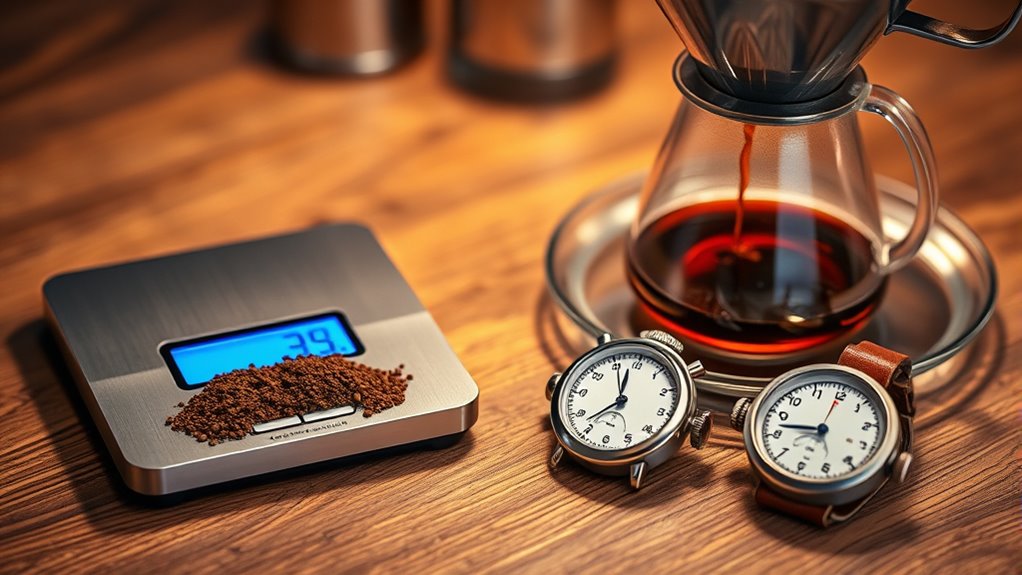
Have you ever wondered how breweries achieve perfect consistency in every batch? It’s no accident—professional brewers rely on precise measurements and controls to ensure each brew tastes just right. When it comes to home brewing or making your own coffee, applying the same principles can elevate your results. Two essential factors that influence the quality of your brew are grind size and water temperature. By paying close attention to these details and using tools like scales and timers, you can master the art of precision brewing.
Start by focusing on your grind size. The consistency of your grind substantially impacts extraction, flavor, and strength. If your grind is too coarse, water flows too quickly, leading to under-extraction and a weak, sour taste. If it’s too fine, water struggles to pass through, resulting in over-extraction and bitterness. Using a scale to measure your beans ensures you’re using the right amount for each brew method, but also pay attention to grind size. Adjust it carefully based on your brewing method—coarser for French press, medium for drip, and finer for espresso. Consistent grind size across batches ensures each cup is balanced and predictable, allowing you to replicate your preferred flavor profile time after time.
Consistent grind size ensures balanced flavor and repeatable results in every brew.
Water temperature is another critical factor that can make or break your coffee. Water that’s too hot can over-extract compounds, making your coffee bitter, while too cool water may under-extract, leaving your brew flat and sour. The ideal water temperature generally falls between 195°F and 205°F (90°C to 96°C). To control this precisely, use a thermometer and a kettle with temperature control, ensuring each brew starts at the perfect temperature. When combined with a timer, you can precisely control how long the water interacts with the grounds. This synchronization helps prevent over- or under-extraction, making your coffee consistently flavorful. Additionally, understanding extraction balance is essential for optimal flavor.
Using a scale to weigh your coffee grounds and water, along with a timer to monitor steeping time, gives you the ability to reproduce your brew perfectly every time. It’s about precision—measuring the exact amount of coffee, maintaining consistent grind size, and starting with the right water temperature. Small adjustments based on your taste preferences become easier to fine-tune when you have accurate data. Over time, these careful measurements help you understand how each variable impacts your final cup, so you can tweak your process for best results. Mastering these details transforms brewing from a guesswork game into a science, giving you the confidence to craft a consistently excellent cup every single time.
Frequently Asked Questions
What Types of Scales Are Best for Precision Brewing?
You should choose a digital scale with a clear digital display for easy reading and precision. Look for one that’s portable, so you can easily carry it around if needed. A good precision brewing scale offers high accuracy, often measuring in grams with tenths of a gram. This helps you dial in your coffee perfectly every time, ensuring consistent results and ideal flavor extraction.
How Do I Calibrate My Scale for Accurate Measurements?
Your scale’s accuracy is as crucial as a compass on a stormy sea. To calibrate, first, make sure it’s on a flat, stable surface. Use calibration weights or follow manufacturer calibration procedures, often involving zeroing the scale and applying known weights. Regularly check your scale’s accuracy with these procedures to keep measurements precise. Proper calibration guarantees your coffee’s flavor remains perfectly balanced every time, no matter the brew.
What Timer Features Should I Look for in a Coffee Brewing Device?
Look for a coffee brewing device with precise timer features that help you achieve brew time consistency. An adjustable timer allows you to control extraction time, ensuring each cup is just right. Also, choose one with versatile timer alarm options, like sound or vibration alerts, so you’re notified when brewing is complete. These features help you refine your process and consistently enjoy perfect coffee every time.
Can I Use a Smartphone as a Timer for Brewing?
Yes, you can use a smartphone as a timer for brewing. Simply set a smartphone alarm or use brewing apps designed for coffee enthusiasts. These apps often include customizable timers and notifications, ensuring you don’t over- or under-extract your coffee. Just make sure your phone’s alarm volume is loud enough, and keep it nearby during brewing for accurate timing and a perfect cup every time.
How Does Water Temperature Affect Brewing Accuracy?
Water temperature acts like a maestro conducting your coffee’s symphony, directly influencing extraction consistency. When water hits the sweet spot, it reveals flavors locked within the beans, but if it’s too hot or cold, the harmony falters. Water chemistry, including mineral content, also plays a role. Maintaining precise temperature ensures your brew’s clarity, balancing acidity and body, so every cup sings with perfection and consistency.
Conclusion
Now, imagine each sip of your perfectly brewed coffee—the rich aroma swirling around you, the warm steam kissing your lips. By using scales and timers, you’re not just making coffee; you’re crafting an experience. Precision turns ordinary mornings into moments of mastery. So, set your scales, start your timers, and watch as the art of brewing transforms your routine into a symphony of flavor. Your perfect cup is just a measurement away.
Fall Picks
fall essentials
As an affiliate, we earn on qualifying purchases.