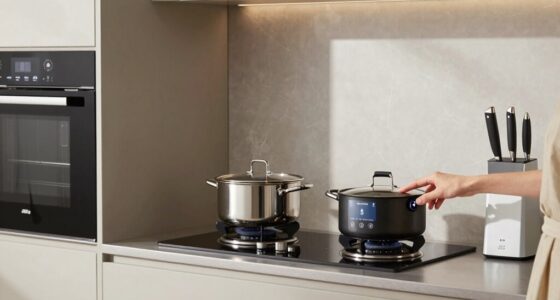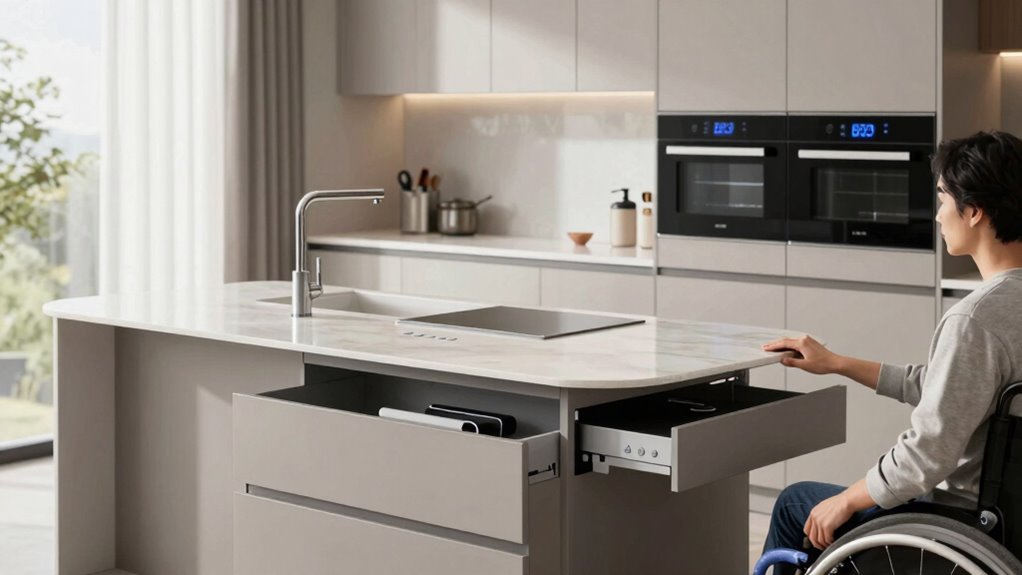

In a modern smart kitchen designed for accessibility, you control lights, appliances, and faucets with easy voice commands or simple touch. Appliances are adjustable to your needs, and smart features improve safety and convenience. Thoughtful layouts ensure you can move easily and reach everything without strain. Integration of sensors, automation, and universal design principles creates a space that fosters independence. Want to find out how these features work together? Keep exploring, and you’ll discover how to make your own kitchen more inclusive.

Get kitchen gear delivered free with Prime
- Fast, free delivery on millions of items
- Prime Video, Amazon Music and more included
- Member-only deals all year
Key Takeaways
- Voice-controlled appliances enable hands-free operation and assist users with mobility challenges.
- Adjustable-height and tactile feedback appliances promote easier access and usability for diverse needs.
- Smart lighting with sensors and voice activation improves visibility and safety in dim or hard-to-reach areas.
- Centralized automation systems simplify daily routines and support independent kitchen management.
- Thoughtful layout and inclusive design ensure accessible movement, easy reach, and seamless device integration.
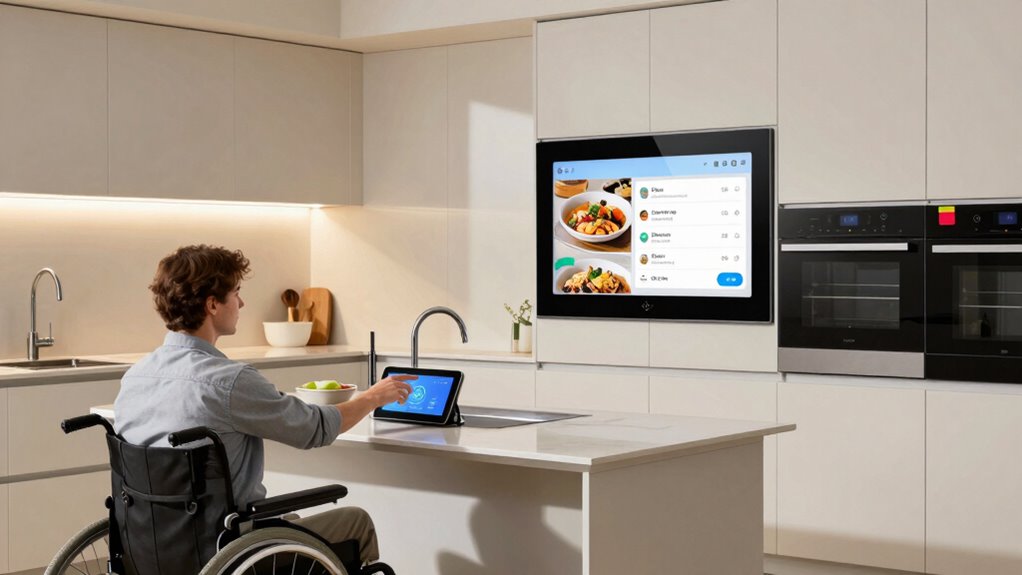
As smart kitchen technology becomes more prevalent, designing for accessibility guarantees everyone can enjoy its benefits. When you incorporate features like voice commands and adaptable appliances, you create an environment that’s intuitive and inclusive. Voice commands allow you to control lights, appliances, and even the faucet without needing to reach or manipulate physical controls. With a simple spoken request, you can turn on the oven, adjust the refrigerator temperature, or start the coffee maker. This hands-free approach caters to those with mobility challenges and makes everyday tasks easier and more efficient.
Voice commands and adaptive appliances make smart kitchens more accessible and effortless for everyone.
Adaptive appliances are another key element of an accessible smart kitchen. These appliances are designed to respond to your specific needs, whether that means adjusting height, providing tactile feedback, or integrating with assistive technologies. For example, some refrigerators feature adjustable shelving and voice-activated inventory management, so you can check what’s inside without opening the door. Ovens with large, tactile controls or voice control capabilities reduce the physical effort required to cook. When you combine adaptive appliances with voice commands, you can operate your kitchen seamlessly, even if you’re managing limited mobility or fine motor challenges. Incorporating accessible design principles ensures the layout and features accommodate a variety of abilities and needs.
Creating an accessible smart kitchen also involves thoughtful design choices. You want to position appliances at comfortable heights and ensure there’s enough space for easy movement. Using smart lighting that can be controlled via voice helps you avoid fumbling with switches, especially in dimly lit conditions. Sensors and motion-activated lights can further enhance convenience, automatically illuminating the space when you enter. These features work together to eliminate barriers and foster independence, allowing you to complete tasks smoothly and confidently. Incorporating smart home integration ensures all devices work in harmony, making the entire kitchen experience more cohesive and accessible. Additionally, considering inclusive design principles can help optimize the layout for diverse needs and abilities.
Furthermore, integrating a centralized smart home system ensures all devices work in harmony. You can set routines or customize controls so that multiple appliances respond to a single command. For example, saying “Good morning” could turn on the coffee, adjust the lighting, and open the blinds, all without needing to interact with individual controls. This level of automation simplifies daily routines, making your kitchen more accessible and user-friendly. Incorporating universal design concepts ensures that the layout and technology are accessible to everyone, regardless of their physical abilities. Emphasizing adaptable features and user-centered design principles can greatly enhance usability for a wider range of users.
voice-controlled smart kitchen appliances
As an affiliate, we earn on qualifying purchases.
As an affiliate, we earn on qualifying purchases.
Frequently Asked Questions
How Do Smart Kitchen Devices Accommodate Users With Visual Impairments?
Smart kitchen devices accommodate users with visual impairments by offering features like high visual contrast on displays, making buttons and screens easier to see. They also incorporate tactile feedback, so you can feel when a button’s pressed or a setting’s activated. These features help you navigate and control devices more independently, ensuring a safer and more accessible cooking experience.
What Safety Features Are Included for Elderly Users?
Imagine a safety net woven into your smart kitchen—elastic yet firm. Elderly users benefit from smart appliance ergonomics, like easy-grip handles and voice-activated controls, reducing strain and fall risks. Adaptive cooking interfaces adjust to individual needs, offering simplified menus or larger displays. These features work together seamlessly, ensuring safety is always at the forefront, so you can cook confidently, knowing your environment adapts to your comfort and security needs.
Can Voice Commands Override Manual Controls?
Yes, voice control can override manual controls in a modern smart kitchen. You can use voice commands to operate appliances, even when manual controls are active. This feature guarantees you have flexible access, especially if your hands are busy or if manual controls are inaccessible. The system prioritizes voice commands, allowing you to seamlessly switch between manual override and voice control, making your kitchen more accessible and convenient.
How Is Accessibility Maintained During Power Outages?
During power outages, accessibility is maintained through emergency preparedness and backup power solutions. You can keep manual controls accessible and functional, like battery-operated switches or backup generators, ensuring you can operate essential appliances. Smart kitchens should include backup power options to keep voice commands and automation systems working in emergencies. This way, you stay safe and connected, even when the main power source fails, maintaining independence and convenience.
Are There Customizable Options for Different Disabilities?
Yes, there are customizable options for different disabilities. Studies show that nearly 15% of the world’s population has some form of disability, emphasizing the importance of inclusive design. You can find adaptive technology and customizable interfaces in modern smart kitchens, allowing you to tailor controls to your specific needs. These options make cooking safer and more accessible, ensuring everyone can enjoy the benefits of a connected, user-friendly environment.
adjustable height smart refrigerator
As an affiliate, we earn on qualifying purchases.
As an affiliate, we earn on qualifying purchases.
Conclusion
As you step into your smart kitchen, think of it as a welcoming lighthouse shining through the fog—guiding every user with clarity and ease. Accessibility isn’t just about technology; it’s the beacon that guarantees no one feels lost or left behind. With thoughtful design, your kitchen becomes a sanctuary where everyone can navigate effortlessly, like a steady hand guiding you home. In this space, inclusivity is the shining star that lights the way forward.
smart lighting with motion sensors
As an affiliate, we earn on qualifying purchases.
As an affiliate, we earn on qualifying purchases.
accessible smart kitchen gadgets
As an affiliate, we earn on qualifying purchases.
As an affiliate, we earn on qualifying purchases.
Halloween Picks
halloween
As an affiliate, we earn on qualifying purchases.