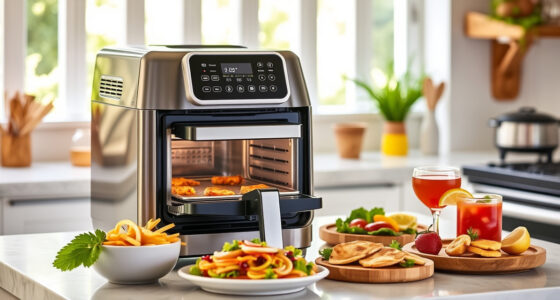
Digital displays appear on both basket-style air fryers and oven-style air fryers, but the display is not the main buying decision. The larger question is whether you want a compact appliance built around a removable cooking basket or a small countertop oven with racks, trays, and extra modes. Basket models are usually the better fit for everyday portions, quick meals, and simple cleanup. Oven models suit households that cook larger batches or want to toast, roast, or dehydrate in the same appliance. The right choice depends on how you cook and how much counter space you can spare.

Get kitchen gear delivered free with Prime
- Fast, free delivery on millions of items
- Prime Video, Amazon Music and more included
- Member-only deals all year

Cosori TurboBlaze 9-in-1 Air Fryer, 6 Qt, PFAS-Free Ceramic Coating
- ✔ Capacity: 6 qt / 5.7 L
- ✔ Temperature range: 90–450°F / 30–230°C
- ✔ Fan speeds: 5

Ninja SP101 Digital Air Fry Countertop Oven, 8-in-1, Silver
- ✔ Model: SP101
- ✔ Functions: Air fry, roast, broil, bake, bagel, toast, dehydrate, keep warm
- ✔ Power: 1,800 watts

Boyuevi 5L Glass Air Fryer with Digital Touchscreen
- ✔ Capacity: 5 liters / 5 quarts
- ✔ Maximum temperature: 400°F
- ✔ Power: 1,200 watts
At a Glance
| Criteria | Basket-style digital air fryers | Oven-style digital air fryers | Winner |
|---|---|---|---|
| Counter space | Compact footprint; basket lifts out | Larger, oven-like footprint | A |
| Cooking capacity | Best for individual or small household portions | More room and often multiple rack positions | B |
| Cooking versatility | Primarily air frying, with some preset programs | Air frying plus functions such as baking, toasting, or dehydrating, depending on model | B |
| Everyday ease | Simple controls and quick access to food | More parts and rack positions to manage | A |
| Batch cooking | May require cooking in multiple rounds | Better suited to cooking several items at once | B |
| Cleanup | Basket and crisper plate are often easy to remove and wash | Trays, racks, and interior may take more effort to clean | A |
| Value | Usually lower-cost for a capable digital air fryer | Higher cost can pay off if extra capacity and modes get regular use | Depends |
Cosori TurboBlaze 9-in-1 Air Fryer, 6 Qt, PFAS-Free Ceramic Coating
For shoppers who want a straightforward digital air fryer, the Cosori TurboBlaze makes the strongest case in this lineup. Its six-quart, square basket is sized for family meals, while the touchscreen controls and five fan speeds give us more cooking adjustment than the Boyuevi’s eight preset programs alone. Its temperature range reaches 450°F, matching the Ninja’s listed upper limit while keeping the appliance in a dedicated air-fryer format.The airflow settings are the key distinction: five fan speeds let us adjust how vigorously air circulates, rather than relying on a single airflow approach. The range from 90°F to 450°F also covers lower-temperature tasks as well as crisping, and the time setting extends up to 24 hours. Those broad controls may appeal to cooks who want to experiment, although someone who prefers a simple preset-and-start routine may not use all the options.Cleaning is another practical advantage. The PFAS-free ceramic-coated basket and crisper tray are dishwasher-safe, a clearer cleanup proposition than the Boyuevi’s glass-and-titanium arrangement. The included recipe book and customizable preheating add guidance and convenience. Against the Ninja, however, the Cosori is less of an all-in-one appliance: it does not list dedicated toast, bagel, bake, or keep-warm functions.We should also account for the installation needs. At 13.2 pounds, this is the heaviest listed air-fryer basket model, and it requires five inches of clearance behind and above the appliance. That makes it a less natural choice for a tightly packed counter or a cabinet where it must be moved often. Still, for a buyer prioritizing a digital screen, adjustable airflow, and family-sized air frying, it is the most balanced recommendation here.
Pros:
- Six-quart square basket suits family-size portions.
- Touchscreen controls, five fan speeds, and temperatures up to 450°F.
- PFAS-free ceramic-coated basket and crisper tray are dishwasher-safe.
- Customizable preheating and noise listed below 53 dB.
Cons:
- Needs five inches of clearance above and behind the appliance.
- At 13.2 pounds, it is relatively heavy to move or store.
Best for: Families or cooks who want a touchscreen air fryer with a roomy basket, adjustable fan speeds, and dishwasher-safe parts.
Not ideal for: Small kitchens with limited overhead or rear clearance, or buyers who want an appliance that also replaces a toaster oven.
Bottom line: We recommend the Cosori as the best all-around digital air fryer here for its family-ready capacity and broad airflow and temperature adjustments.
“We recommend the Cosori as the best all-around digital air fryer here for its family-ready capacity and broad airflow and temperature adjustments.”
Ninja SP101 Digital Air Fry Countertop Oven, 8-in-1, Silver
The Ninja SP101 is the outlier that earns its place by doing more than air frying. Its eight functions include air fry, roast, broil, bake, bagel, toast, dehydrate, and keep warm. If we want one appliance for weeknight crisping and everyday oven or toaster tasks, that breadth can be more useful than the dedicated basket format of the Cosori or Boyuevi.Its capacity is described in familiar meal terms: it fits a 13-inch pizza, up to nine slices of toast, or six chicken breasts. That low, wide cooking surface accommodates foods that may be awkward in a basket. The flip-up design also helps reclaim counter space after use, a useful contrast with the Cosori, which needs clearance above and behind it, and the Boyuevi, whose glass basket may take more storage room.There is an important interface caveat for this roundup. The product description identifies a digital air-fry oven, but the specification lists a knob control, while both other picks explicitly list touchscreen controls. Buyers who specifically want a touchscreen display should favor the Cosori or Boyuevi. We rank the Ninja for function and format rather than claiming it offers the same touch interface.At 1,800 watts, it has the highest stated power in this group, and its preheat time is listed as 60 seconds. It comes with an air-fry basket, sheet pan, wire rack, and removable crumb tray; an accessible back panel supports cleaning. The compromises are the counter footprint while cooking and a temperature range given as 250–450 without a unit in the supplied specifications. That ambiguity makes the range less informative than the explicitly stated Fahrenheit ranges on the other models.
Pros:
- Eight functions include air fry, toast, bake, and dehydrate.
- Fits a 13-inch pizza, nine slices of toast, or six chicken breasts.
- Flip-up design helps free counter space when stored.
- Includes an air-fry basket, sheet pan, wire rack, and removable crumb tray.
Cons:
- Specifications list a knob control, not a touchscreen.
- Needs counter space while in use, and the temperature unit is unspecified.
Best for: Cooks who want a countertop oven that can air fry, toast, bake, and handle several other cooking tasks.
Not ideal for: Buyers set on a touchscreen interface or a compact appliance that can stay on the counter in a very small kitchen.
Bottom line: Choose the Ninja when oven and toaster functions matter as much as air frying, and verify the knob-based interface suits your expectations.
“Choose the Ninja when oven and toaster functions matter as much as air frying, and verify the knob-based interface suits your expectations.”
Boyuevi 5L Glass Air Fryer with Digital Touchscreen
The Boyuevi 5L Glass Air Fryer is the most distinctive choice for shoppers who want to watch food cook or avoid a coated inner pot. Its borosilicate glass basket provides a view of the food, while the titanium inner pot is listed as uncoated. Compared with the Cosori’s opaque, ceramic-coated basket, this construction puts visibility and material preference at the center of the buying decision.Its touchscreen offers eight presets, making common cooking choices accessible without requiring the buyer to explore several airflow levels. The Cosori gives more explicit control over fan speed and temperature range; the Boyuevi instead combines presets with a programmable timer of up to 24 hours. We would treat that long timer as flexibility for planned cooking rather than a reason to leave food unattended, and the product details do not explain how timer programming works.The 5-liter capacity is substantial for a basket air fryer and is close to the Cosori’s 5.7-liter volume, though the Cosori is somewhat larger by the stated figures. The Boyuevi reaches 400°F, lower than the 450°F maximum listed for both the Cosori and Ninja. Its 11-blade fan and 300-degree rotating airflow are presented as the circulation system, but the supplied details do not give an equivalent set of adjustable airflow speeds like the Cosori’s five levels.There is a practical cost to the glass design: the basket may be bulky to handle and store. At 11.5 pounds it is lighter than the Cosori, but material and shape can still make day-to-day lifting less convenient than a conventional basket. It also lacks the Ninja’s broader oven functions. We see this as a focused option for cooks who value a visible cooking chamber and an uncoated inner pot more than top-end temperature, adjustable fan speeds, or toaster-oven versatility.
Pros:
- Borosilicate glass basket lets us view food during cooking.
- Uncoated titanium inner pot avoids a nonstick coating.
- Touchscreen controls include eight presets.
- Five-liter capacity and programmable timer up to 24 hours.
Cons:
- Glass basket may be bulky to handle and store.
- Maximum temperature of 400°F is below the other models’ listed 450 maximum.
Best for: Cooks who want to monitor food through a glass basket and prefer an uncoated titanium inner pot.
Not ideal for: Anyone seeking a compact basket to handle, a maximum temperature above 400°F, or a multi-function countertop oven.
Bottom line: The Boyuevi is a specialized pick for visibility and uncoated cookware, with a lower temperature ceiling and less convenient basket handling as tradeoffs.
“The Boyuevi is a specialized pick for visibility and uncoated cookware, with a lower temperature ceiling and less convenient basket handling as tradeoffs.”
As an Amazon Associate we earn from qualifying purchases.
Key Differences
The strongest practical difference is the cooking layout. A basket model keeps food in one pull-out compartment, so it is easy to load, shake, check, and serve. That arrangement works particularly well for fries, vegetables, wings, and other foods that benefit from being moved during cooking. An oven-style model spreads food across racks or trays. That creates room for more food and can accommodate different shapes, but items on separate levels may cook unevenly unless the food is rearranged or the trays are rotated.
Versatility is the oven-style format’s main advantage, though the label alone does not guarantee better results. Some models add useful modes such as toast, bake, or dehydrate; others mainly provide presets for air frying. Basket models can also have digital programs, but those controls do not make them equivalent to a toaster oven. Compare the actual functions and capacity of each model rather than assuming that a longer preset list means more useful cooking options.
For many buyers, value comes down to frequency of use. If most meals are one or two portions of foods suited to a basket, a basket-style air fryer is usually the better value: it takes less room and handles the core job with fewer parts. Paying more for an oven style makes sense when the extra room or cooking modes replace tasks you regularly perform in another appliance. A large appliance that does not fit the counter or rarely leaves storage is poor value, even if its feature list is longer.
Detailed Comparison
Counter space (Basket-style digital air fryers wins — moderate)
Basket-style models win by a moderate margin for kitchens where worktop space is limited. Their upright, compact layout is usually easier to accommodate, and the basket can be removed without opening a door and pulling out a tray. Oven-style models occupy more of the counter, so measure the appliance and leave room for ventilation and access before buying. If the appliance will stay out and the kitchen has space, the larger footprint may be an acceptable trade for more cooking room.
Cooking capacity (Oven-style digital air fryers wins — moderate)
Oven-style models usually win for capacity, with a moderate gap that varies by model. Racks and trays can spread food across a wider cooking area, while a basket concentrates it in one chamber. That can help with larger portions, but published capacity is not the whole story: food needs room for hot air to circulate, and stacking or crowding can reduce crispness. For one or two servings, a smaller basket may be more practical than a larger appliance.
Cooking versatility (Oven-style digital air fryers wins — moderate)
Oven-style models win by a moderate margin when they include modes such as toast, bake, or dehydrate. Those functions can make the appliance useful beyond air-fried food. The advantage depends on the model’s actual features and performance; a digital screen by itself does not add cooking capability. Basket models keep the focus on air frying and may offer several presets, which is useful for routine meals but does not provide the same oven-like layout.
Everyday ease (Basket-style digital air fryers wins — minor)
Basket-style models usually win by a minor to moderate margin for straightforward daily cooking. The user pulls out one basket, puts in food, and can shake it partway through. Oven-style models require choosing a rack or tray and may need the food moved between levels. Digital controls can make time and temperature easy to set on either type, but touchscreen complexity and preset names differ by model. Buyers who value simple routines should prioritize clear controls over the number of presets.
Cooking several foods at once (Oven-style digital air fryers wins — moderate)
Oven-style models win by a moderate margin for meals with multiple components or larger quantities. Separate racks can hold different foods, though cooking times and temperatures may not match, and trays may need rotating. Basket models are more contained and convenient for a single food, but filling the basket too heavily can prevent even browning. For a household that often cooks several portions together, an oven layout is generally more useful.
Cleanup (Basket-style digital air fryers wins — minor)
Basket-style models usually win by a minor margin because the main food-contact parts lift out and are often dishwasher-safe, subject to the manufacturer’s instructions. Oven-style models can leave users with multiple trays or racks to wash, plus an interior that may need wiping. A removable crumb tray helps, but it does not eliminate the extra parts. Cleanup depends on coatings and design, so check care instructions before purchase.
Value for money (moderate difference)
There is no universal winner. Basket models typically cost less for the core task of air frying, so they offer stronger value when capacity and extra modes would go unused. Oven-style models can justify their higher price if they regularly handle larger batches or replace another countertop appliance. The practical test is whether the extra functions solve a recurring need. Paying more for a display, extra presets, or capacity you will not use does not improve value.
Basket-style digital air fryers: Pros and Cons
Pros:
- Compact and generally easier to fit on a counter
- Straightforward basket access suits common air-fried foods
- Often simpler to clean, with fewer removable parts
- Usually costs less than a larger oven-style model
Cons:
- May need multiple rounds for larger meals
- Less useful for toast, baking, or other oven-style tasks
- Crowding the basket can limit even cooking
Oven-style digital air fryers: Pros and Cons
Pros:
- More cooking area for larger portions or several items
- May combine air frying with baking, toasting, or dehydrating
- Rack and tray layout can accommodate foods that do not fit neatly in a basket
Cons:
- Takes more counter space
- Extra racks and trays can add cleanup work
- Multiple levels may need attention for even cooking
- Often costs more, and the added features may go unused
Who Should Choose What
Choose Basket-style digital air fryers if:
- You usually cook one or two portions at a time.
- You want a compact appliance for fries, vegetables, or similar air-fried foods.
- You prefer a simple removable basket and fewer parts to wash.
- You want digital time and temperature controls without paying for oven-style functions.
Choose Oven-style digital air fryers if:
- You regularly cook larger batches or several items at once.
- You will use additional modes such as toast, bake, or dehydrate.
- You have enough counter space for an oven-shaped appliance.
- The appliance can replace another countertop cooker you use often.
Skip both if: Your kitchen has little storage or counter space and you already have an oven that handles your usual meals well.
Value for Money
Basket-style models are usually the better value for buyers who want digital control over everyday air frying. They focus spending on the core task, occupy less space, and tend to have fewer pieces to clean. The lower price matters most when meals are small and the appliance will be used often; the savings are less meaningful if the basket is too small for the portions you routinely cook.
Pay more for an oven-style model when its added capacity or cooking modes will see regular use. It may be worthwhile if it replaces a toaster oven or lets you cook larger meals in one round. Compare usable rack area, stated functions, cleaning instructions, and the required counter clearance. If the extra functions are occasional curiosities, a basket model is the more sensible purchase.
Final Verdict
For most people buying a digital air fryer mainly to cook quick portions of crisp foods, choose a basket-style model. It is compact, direct to use, and usually less demanding to clean. Choose an oven-style model if you routinely cook for several people, need rack space, or will use its additional cooking modes enough to justify the larger footprint and price. The biggest deciding factor is not the display: it is whether your meals call for one easy basket or a more versatile countertop oven.
Frequently Asked Questions
Is an oven-style digital air fryer better than a basket model?
It is better for larger batches and for people who will use its added modes. A basket model is generally easier to fit, use, and clean when the main goal is air frying small or medium portions.
Does a digital display make an air fryer cook better?
A display can make it easier to set and read cooking time and temperature, but it does not guarantee better cooking. Capacity, airflow, layout, and how much food is loaded have more direct effects on results.
Which type is easier to clean?
Basket models usually have fewer removable parts, so cleanup is often simpler. Oven-style models may require washing several racks or trays and wiping the interior. Check whether the parts are dishwasher-safe and follow the maker’s care instructions.
Is paying more for an oven-style air fryer worth it?
It can be if you regularly need the extra room or use functions such as toast and bake. If you mainly cook a few portions of air-fried food, the added cost and counter space are unlikely to pay off.