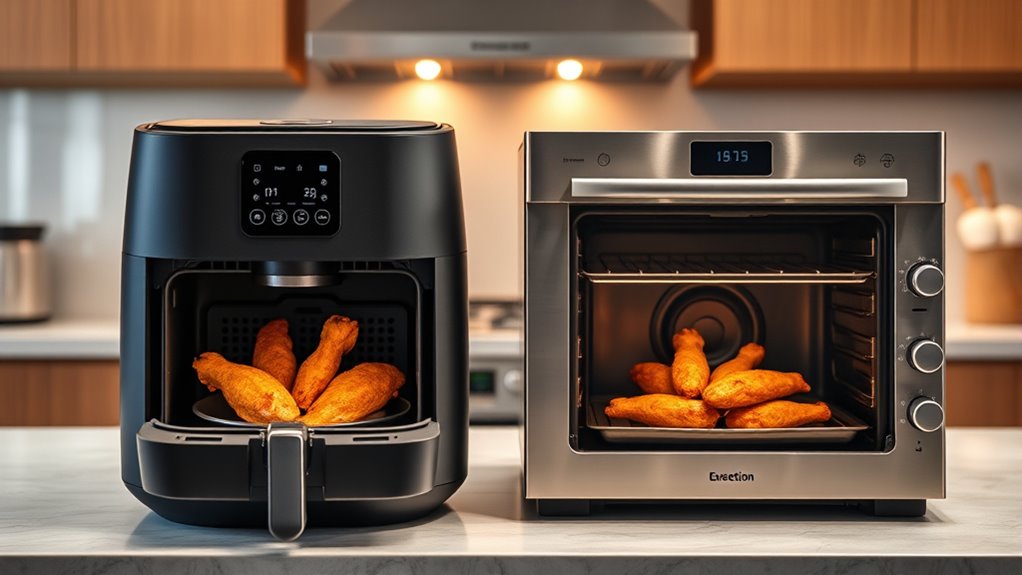

If you want faster, energy-efficient results, an air fryer is your best choice, cooking food quickly with intense crispiness and easy cleanup. A convection oven offers more versatility, larger capacity, and even browning for bigger meals. While air fryers excel in quick snacks and small portions, convection ovens handle bigger dishes and complex recipes better. To discover which appliance suits your needs best, explore the detailed differences that follow.
Key Takeaways
- Air fryers heat up faster and cook food more quickly due to rapid air circulation and smaller chambers.
- Convection ovens offer more even heat distribution and versatility for a wider range of recipes and techniques.
- Air fryers excel at crisping and browning foods effectively with less moisture loss.
- Convection ovens are better suited for larger quantities and complex dishes requiring precise temperature control.
- Overall, both appliances cook well; choice depends on desired textures, cooking volume, and convenience.
Speed and Cooking Time Comparison
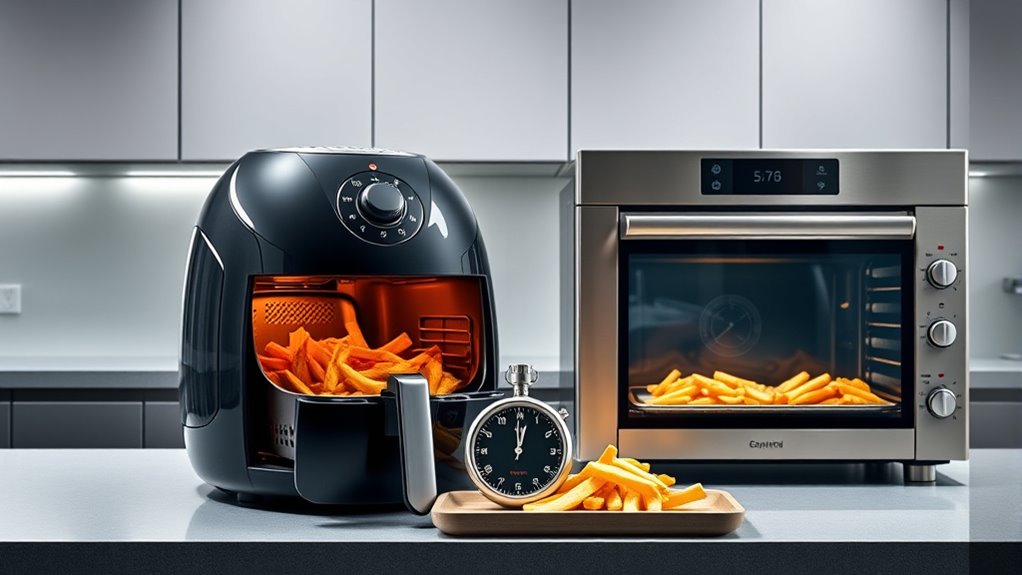
When comparing speed and cooking time, an air fryer typically heats up faster and cooks food more quickly than a convection oven. Its preheating duration is minimal, often just a few minutes, allowing you to start cooking almost immediately. This efficiency stems from its smaller cooking chamber and rapid air circulation. Additionally, an air fryer generally consumes less power because it reaches the desired temperature faster and maintains it more efficiently. In contrast, a convection oven takes longer to preheat and often uses more energy during extended cooking times. If you’re looking to save time and reduce energy consumption, an air fryer offers a clear advantage. Its quick heating and faster cooking cycle make it a convenient choice for busy kitchens. High efficiency in design further enhances its ability to cook quickly and save energy. Moreover, the compact size of an air fryer makes it easier to store and use in limited kitchen spaces. Furthermore, the precise temperature control of modern air fryers helps ensure evenly cooked results, which is essential for many recipes. Additionally, the thermal behavior of an air fryer allows for more consistent cooking outcomes. Incorporating the energy-efficient technology of air fryers can also contribute to lowering overall household energy use.
Versatility and Cooking Options

Both air fryers and convection ovens offer a wide range of recipes, but their flexibility with cooking techniques varies. You can prepare everything from crispy snacks to baked goods with either appliance, yet some methods are more suited to one. Understanding their versatility helps you choose the right tool for your cooking style and needs. Additionally, connected cooking features in modern appliances can enhance your experience by enabling remote control and automation. As these features become more common, they expand the cooking options available and can help optimize your meal preparation process. Recognizing the cooking techniques each appliance supports can further assist in selecting the most suitable option for your culinary preferences, especially considering their versatility in handling different recipes. Moreover, understanding the appliance capabilities can guide you toward making an informed decision based on your specific cooking goals.
Range of Recipes
The range of recipes you can prepare with an air fryer or convection oven highlights their versatility and makes them valuable kitchen tools. Both appliances excel beyond simple frying or baking, allowing you to make a variety of dessert recipes like cookies, muffins, and even small cakes. You can also prepare beverages, such as warming milk or making infused drinks, thanks to their even heat distribution. An air fryer’s quick-prep capabilities let you create crispy snacks and decadent treats, while a convection oven handles larger batches and complex recipes. This flexibility means you can experiment with different cuisines and cooking styles, making these appliances essential for both everyday meals and special occasions. Their broad recipe range ensures you won’t be limited in what you can cook.
Cooking Techniques Flexibility
Thanks to their advanced heating technologies, air fryers and convection ovens offer remarkable flexibility in cooking techniques. You can prepare everything from crispy appetizers to baked desserts, making them perfect for dinner parties or quick weeknight meals. The convection process guarantees even cooking, so you can roast vegetables, bake bread, or reheat leftovers efficiently. With an air fryer, you can achieve a fried texture without oil, ideal for healthier meal prepping. Convection ovens, on the other hand, often feature multiple racks, allowing you to cook several dishes simultaneously. This versatility means you’re not limited to just frying or baking—you can sear, broil, or dehydrate, expanding your culinary options and simplifying meal prep for any occasion.
Quality of Results and Texture

When comparing the results, you’ll notice that both appliances aim for crispy, browned finishes, but they may attain different textures. Moisture retention is also key, affecting how juicy or tender your food turns out. Additionally, uniform cooking performance ensures each bite is consistent, no matter which device you use. Understanding the technology differences between air fryers and convection ovens can help you choose the best appliance for your cooking needs. Recognizing the cooking mechanisms can also help you anticipate the final texture and moisture levels of your dishes. Moreover, factors like heat distribution play a crucial role in achieving consistent results across different foods.
Crispiness and Browning
Crispiness and browning are key factors that often determine whether you’ll prefer an air fryer or a convection oven. With an air fryer, you typically get a more even, intense crisp, thanks to rapid air circulation that mimics deep frying. Convection ovens can also brown well but may require longer cooking times or higher temperatures. Your seasoning techniques influence how well the surface browns—using oil or marinades enhances crispiness. Proper cleaning methods, like removing grease and crumbs, make certain of consistent heat transfer and prevent uneven browning. You’ll find that maintaining your appliance’s cleanliness helps achieve better crusts and more attractive color. Additionally, choosing high-quality home decor and gift ideas can enhance your kitchen’s aesthetic and functionality. Ultimately, your choice depends on the texture you want: crisp and golden or slightly softer with a traditional finish.
Moisture Retention
Moisture retention plays a significant role in the overall quality of your cooked foods, influencing both texture and juiciness. An appliance that preserves moisture helps keep dishes tender and flavorful, preventing them from drying out. When comparing an air fryer and a convection oven, you’ll notice that moisture retention impacts not only taste but also kitchen aesthetics by reducing steam and excess moisture. Additionally, noise levels play a subtle role; quieter appliances are less disruptive, allowing you to focus on maintaining food quality. The air fryer’s rapid cooking can sometimes lead to drier results, while convection ovens often retain more moisture if used carefully. Ultimately, your choice should consider how well each appliance preserves moisture, ensuring your dishes stay juicy and appealing.
Uniform Cooking Performance
Both an air fryer and a convection oven aim to deliver evenly cooked foods, but they achieve this with different results. An air fryer typically provides faster, more consistent cooking due to its compact size and rapid air circulation, leading to a crisp exterior and tender interior. In contrast, a convection oven often offers more uniform results across larger batches, although it may produce slightly more cooking noise during operation. When it comes to cleaning procedures, an air fryer’s basket and tray are easier to clean but can require more frequent attention. A convection oven’s interior might need thorough wiping, but its larger space makes cleaning less frequent. Additionally, filtration efficiency in these appliances can influence the overall quality of results, especially for allergy sufferers. Proper airflow management can also enhance cooking outcomes by ensuring heat is distributed evenly throughout the appliance. It is also important to consider performance consistency to achieve reliable results over time. Regular calibration and maintenance can help maintain optimal cooking performance. Overall, both appliances can deliver great results, but your choice depends on your preferred texture and convenience.
Ease of Use and Convenience
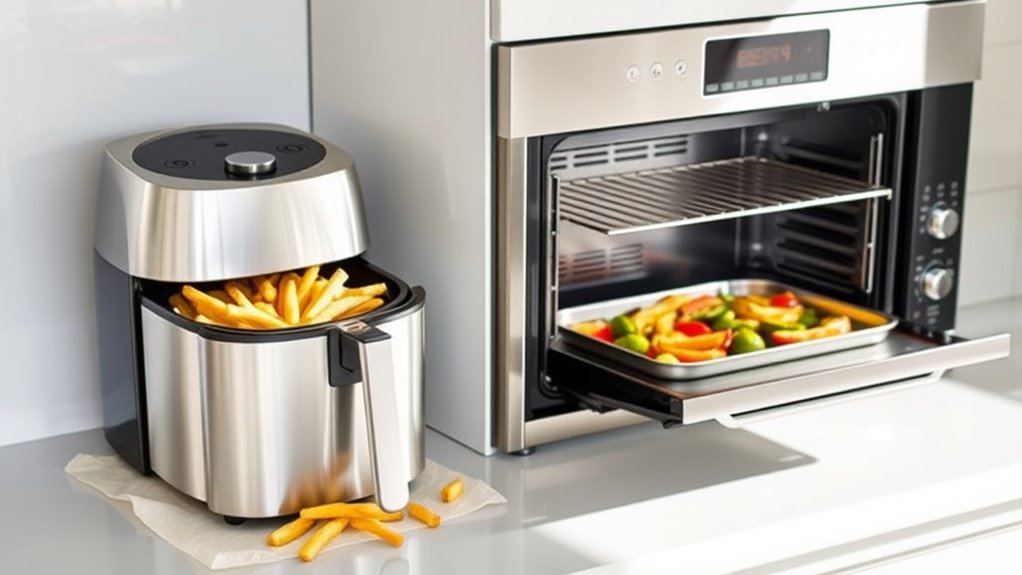
While both air fryers and convection ovens are designed to make cooking easier, they differ considerably in their ease of use and convenience. An air fryer typically features a simple user interface with touchscreen controls or dials, making it quick to select preset functions and temperature settings. Its compact size means less time spent managing settings, and many models have straightforward cleaning processes—removable trays and non-stick surfaces simplify cleanup. Convection ovens, on the other hand, often come with more complex controls and multiple functions, which can be overwhelming initially. However, they usually have larger surfaces, requiring more effort to clean. Additionally, the cultural diversity of various models offers different features tailored to specific cooking needs. Overall, if you prioritize quick setup and minimal cleanup, an air fryer offers more convenience, whereas convection ovens demand a bit more time but provide versatility and multiple cooking options.
Size, Capacity, and Kitchen Space

When considering ease of use, size and capacity become important factors that can influence your overall experience in the kitchen. An air fryer’s compact design fits easily on countertops, helping maintain a clean kitchen aesthetic without sacrificing much space. Its smaller size means it’s more portable and easier to store when not in use. Conversely, convection ovens are larger and require more countertop or cabinet space, which can impact your kitchen’s look and functionality. Durability varies; well-made appliances withstand daily use, but larger models may be more prone to wear over time. Your choice depends on your available space and how much capacity you need. If space is limited, an air fryer offers a practical, space-efficient solution with good appliance durability. Additionally, considering herbal infusion tools can enhance your culinary versatility. When selecting appliances, understanding field‑of‑view and imaging‑scale can also help optimize your kitchen setup for efficiency and accessibility. Moreover, reviewing product lifespan and maintenance can help ensure your investment lasts over time, especially in terms of long-term durability.
Cost and Energy Efficiency
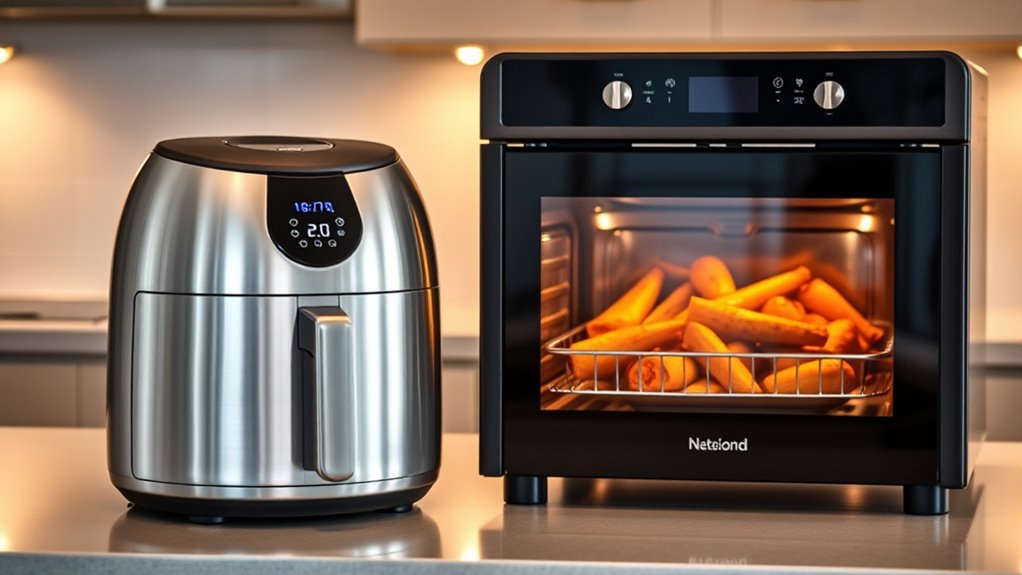
Cost and energy efficiency are key factors to contemplate when choosing between an air fryer and a convection oven. Generally, air fryers have lower upfront costs and use less energy due to their smaller size and faster cooking times. Convection ovens tend to consume more energy but can handle larger quantities, making them cost-effective for bigger meals over time. Consider the table below:
| Feature | Air Fryer | Convection Oven |
|---|---|---|
| Upfront Costs | Lower | Higher |
| Energy Savings | Higher (efficient for small batches) | Moderate (better for large meals) |
| Cooking Speed | Faster | Slightly slower |
| Capacity | Limited | Larger |
| Maintenance | Less frequent | Requires more cleaning |
Frequently Asked Questions
Which Appliance Is Better for Baking Desserts?
For dessert baking and cake preparation, a convection oven is better because it offers more even heat distribution, ensuring your desserts cook uniformly. You can bake larger batches or delicate pastries without worrying about uneven spots. While air fryers work well for quick snacks, convection ovens provide consistent results for cakes and other desserts, making them the ideal choice if you prioritize perfect, fluffy baked goods.
Can an Air Fryer Replace a Traditional Oven Entirely?
You can’t expect an air fryer to replace a traditional oven entirely—it’s like comparing a pocket knife to a Swiss Army. While an electric countertop air fryer offers quick, crispy results, it can’t match a built-in or gas oven’s capacity for large dishes or baking. Think of it as a helpful tool, but not a complete substitute for the versatility of a full-sized oven.
How Do Cleaning and Maintenance Differ?
You’ll find cleaning processes for air fryers are simpler, often needing just a quick wipe or removal of the basket and tray. Convection ovens require more effort, including cleaning larger surfaces and sometimes deep cleaning. Maintenance requirements differ as air fryers have fewer moving parts and less complexity, while convection ovens may need regular checks on heating elements and fans. Overall, air fryers demand less frequent and easier maintenance.
Are There Health Benefits to Using an Air Fryer?
Did you know that using an air fryer can cut your oil intake by up to 75%? This means you enjoy the same crispy textures with less fat, promoting better health. Air fryers offer significant oil reduction, leading to improved nutritional benefits. By choosing an air fryer, you can indulge in healthier meals without sacrificing flavor, making it a smart choice for your wellness goals.
Which Appliance Is More Suitable for Large Families?
A convection oven is more suitable for large families because it handles bigger quantities, saving you time and effort. It’s energy-efficient and can cook multiple dishes simultaneously, which is ideal for feeding more people. Plus, it doesn’t take up much more countertop space than an air fryer, making it practical if your kitchen is limited. Overall, a convection oven helps you prepare larger meals efficiently and conveniently.
Conclusion
Choosing between an air fryer and a convection oven is like picking between a swift arrow and a steady boat—each has its strengths. The air fryer offers quick, crispy results, while the convection oven sails through larger batches with versatility. Think of it as finding the right tool to paint your kitchen masterpiece. Whichever you choose, you’re crafting delicious moments—your kitchen becomes a canvas, and these appliances are your brushes, ready to bring your culinary dreams to life.